ISQGD Conferences
This page presents upcoming international conferences organized through the ISQGD Conference Center, an academic unit of the ISQGD Academic Center. These conferences provide inclusive forums for students, educators, researchers, and professionals to present scholarly work, exchange ideas, build meaningful collaborations, and engage with the global academic community.
Upcoming Conferences & Quick Navigation
Have Questions About ISQGD?
Many common questions about ISQGD memberships, conferences, ISQGD academic clubs, ISQGD Books, certificates, publications, volunteer opportunities, and other academic and educational activities are answered in our Frequently Asked Questions (FAQ).
Global Scheduling and Time-Zone Coordination
ISQGD serves an international community, and many of its conferences, academic clubs, lectures, workshops, special sessions, meetings, and other online activities involve participants from multiple countries and time zones. Unless an activity-specific announcement states otherwise, U.S. Central Time (America/Chicago) is used as the standard reference time for ISQGD scheduling.
Whenever an ISQGD activity includes scheduled talks, sessions, or meetings, the official schedule will state the reference time clearly. Published talk and session schedules will also include appropriate local-time conversion information so that participants in different regions can identify the corresponding time in their location.
To facilitate meaningful participation across different parts of the world, ISQGD activities may be scheduled during both U.S. daytime and U.S. evening or nighttime hours, depending on the locations of speakers and participants. Activities taking place outside normal U.S. daytime hours may be coordinated and conducted by authorized ISQGD session coordinators or volunteers located in other regions of the world.
This distributed scheduling approach enables ISQGD to support international participation while maintaining a clear common reference time and consistent coordination across its global academic and educational activities.
ISQGD Conferences
Organized through the ISQGD Conference Center, ISQGD Conferences provide international forums for students, educators, researchers, and professionals to present scholarly work, exchange ideas, foster collaboration, and engage with the global mathematical, scientific, educational, and interdisciplinary community.
Date: October 17–18, 2026 (Saturday–Sunday)
Format: Online via Zoom
Organizer: International Society for Quality Growth and Development (ISQGD)
🌍 Global Scheduling & Time-Zone Coordination
Conference Overview
The International Conference on Undergraduate and Graduate Research in Mathematics provides an international forum for undergraduate and graduate students to present mathematical research, share ideas, and engage in scholarly discussion. Organized by the International Society for Quality Growth and Development (ISQGD), this two-day conference emphasizes student research in pure and applied mathematics and interdisciplinary mathematical work.
Research Areas
Research in all areas of mathematics is welcome, including algebra, number theory, discrete mathematics, analysis, differential equations, geometry, topology, dynamical systems, probability, statistics, optimization, numerical analysis, mathematical modeling, and mathematical foundations of data science. Interdisciplinary research with a substantial mathematical component is also welcome.
Academic Scope
The conference welcomes undergraduate and graduate research presentations, including thesis and dissertation research, supervised research projects, and carefully developed mathematical investigations. Presentations should explain the research question, mathematical approach, results or progress, and the student presenter’s contribution.
Speaker Registration and Abstract Submission
Registration, Title, and Abstract Submission Deadline: October 5, 2026
Undergraduate and graduate students are invited to submit the title and abstract of their research presentation. Abstracts should describe the mathematical topic, research question, methods, and main results or progress. As speaking slots are limited, early submission is strongly encouraged.
Conference Format
The conference will be conducted fully online via Zoom. The detailed schedule will be prepared after abstracts are received. In arranging the program, ISQGD will take into consideration participants joining from different countries, geographical regions, and time zones. Specific presentation times and Zoom-session details will be announced in the final conference program.
Presentation Format
Each speaking slot is 30 minutes — 25 minutes for the presentation, followed by 5 minutes for questions, discussion, and transition to the next talk. All talks will begin at their scheduled times. Speakers are requested to keep within their allotted time so that subsequent talks can start promptly.
Limited Speaking Slots
As the number of speaking slots is limited, interested speakers are strongly encouraged to complete their registration and submit their presentation title and abstract at their earliest convenience, and in all cases before the submission deadline.
Speaker Registration Fees
The permanent ISQGD event rates below apply to eligible individuals presenting talks. Active ISQGD Annual Members receive the 20% discounted rates shown below:
• Primary / Middle / High School Student Speaker: USD 10
• Annual Member — Primary / Middle / High School Student: USD 8
• Undergraduate / Graduate Student / Independent Scholar / Teacher / Lecturer Speaker: USD 15
• Annual Member — Undergraduate / Graduate Student / Independent Scholar / Teacher / Lecturer: USD 12
• Faculty / Postdoctoral Researcher Speaker: USD 20
• Annual Member — Faculty / Postdoctoral Researcher: USD 16
💳 Conference Registration Payment
General Conference Inquiries
✉ office@isqgd.org
Date: October 24–25, 2026 (Saturday–Sunday)
Format: Online via Zoom
Conference Structure: Two Parallel Sessions
🌍 Global Scheduling & Time-Zone Coordination
Conference Overview
The International Society for Quality Growth and Development (ISQGD) will organize this two-day international conference as a global forum for scholarly exchange in Probability, Statistics, Data Science, and Artificial Intelligence. The program is designed to connect foundational theory with contemporary statistical, computational, and data-driven research, while encouraging communication and collaboration across the mathematical, scientific, technological, and interdisciplinary communities.
Two Parallel Sessions
The conference will be organized around two parallel Sessions representing broad areas of probability, statistics, data science, and artificial intelligence. Each session welcomes specialized research talks, expository presentations, computational work, and accessible presentations of wider interdisciplinary interest. The research areas listed below are representative rather than exhaustive. Interdisciplinary work is especially encouraged; when a talk overlaps both sessions, speakers should select the session that best reflects the primary focus of the presentation.
Session A — Probability & Statistics
Representative research areas include:
Probability Theory; Measure-Theoretic Probability; Applied Probability; Stochastic Processes; Stochastic Analysis; Random Variables and Probability Distributions; Limit Theorems; Markov Chains and Markov Processes; Martingales; Brownian Motion; Stochastic Differential Equations; Mathematical Statistics; Statistical Theory; Statistical Inference; Bayesian Statistics; Applied Statistics; Biostatistics; Time-Series Analysis; Survival Analysis; Multivariate Analysis; Spatial Statistics; Experimental Design; Statistical Modeling; Actuarial Science; Reliability Theory; and related areas.
Session B — Data Science & Artificial Intelligence
Representative research areas include:
Data Science; Data Analytics; Machine Learning; Artificial Intelligence; Deep Learning; Neural Networks; Statistical Learning; Predictive Modeling; Classification and Clustering; Data Mining; Big Data Analytics; Computer Vision; Natural Language Processing (NLP); Pattern Recognition; Intelligent Systems; Explainable Artificial Intelligence; Generative Artificial Intelligence; Reinforcement Learning; Mathematical Foundations of Machine Learning; Optimization for Machine Learning and Artificial Intelligence; Computational Methods for Data-Intensive Research; Scientific Machine Learning; AI Applications in Science and Engineering; and related interdisciplinary areas.
Choosing a Session: Session A is intended primarily for work whose central contribution is in probability or statistical theory, methodology, or application. Session B is intended primarily for work centered on data-driven computation, machine learning, or artificial intelligence. When a presentation genuinely spans both areas, the speaker should choose the session that best reflects the principal contribution of the work; the organizers may recommend reassignment when helpful for the academic balance of the program.
Academic Scope
The conference welcomes original research, methodological and expository contributions, applications, and carefully prepared student research or project presentations. Work connecting these fields with science, engineering, technology, medicine and health, economics and finance, education, or other areas of societal importance is also welcome.
Speaker Registration and Abstract Submission
Title and Abstract Submission Deadline: October 4, 2026
Faculty members, researchers, postdoctoral scholars, graduate and undergraduate students, educators, professionals, independent scholars, and other qualified participants are welcome to register for a presentation and submit the title and abstract of their talk. Speakers should select the session that best matches the primary focus of their presentation. As presentation slots are limited, early submission is strongly encouraged.
Please select one of the following sessions in the registration form:
- Session A — Probability & Statistics
- Session B — Data Science & Artificial Intelligence
Conference Format
The conference will be conducted fully online via Zoom. The detailed schedule will be prepared after abstracts are received. In arranging the program, ISQGD will take into consideration participants joining from different countries, geographical regions, and time zones. Specific presentation times and Zoom-session details will be announced in the final conference program.
Presentation Format
Each speaking slot is 30 minutes — 25 minutes for the presentation, followed by 5 minutes for questions, discussion, and transition to the next talk. All talks will begin at their scheduled times. Speakers are requested to keep within their allotted time so that subsequent talks can start promptly.
Limited Speaking Slots
As the number of speaking slots is limited, interested speakers are strongly encouraged to complete their registration and submit their presentation title and abstract at their earliest convenience, and in all cases before the submission deadline.
Speaker Registration Fees
The permanent ISQGD event rates below apply to eligible individuals presenting talks. Active ISQGD Annual Members receive the 20% discounted rates shown below:
• Primary / Middle / High School Student Speaker: USD 10
• Annual Member — Primary / Middle / High School Student: USD 8
• Undergraduate / Graduate Student / Independent Scholar / Teacher / Lecturer Speaker: USD 15
• Annual Member — Undergraduate / Graduate Student / Independent Scholar / Teacher / Lecturer: USD 12
• Faculty / Postdoctoral Researcher Speaker: USD 20
• Annual Member — Faculty / Postdoctoral Researcher: USD 16
💳 Conference Registration Payment
General Conference Inquiries
✉ office@isqgd.org
Date: November 21–22, 2026 (Saturday–Sunday)
Format: Online via Zoom
Official Time Zone: U.S. Central Time (America/Chicago)
🌍 Global Scheduling & Time-Zone Coordination
📄 Official Conference Flyer
Download, print, and share the official conference flyer with universities, schools, mathematics departments, faculty members, teachers, students, mathematics clubs, and academic communities worldwide.
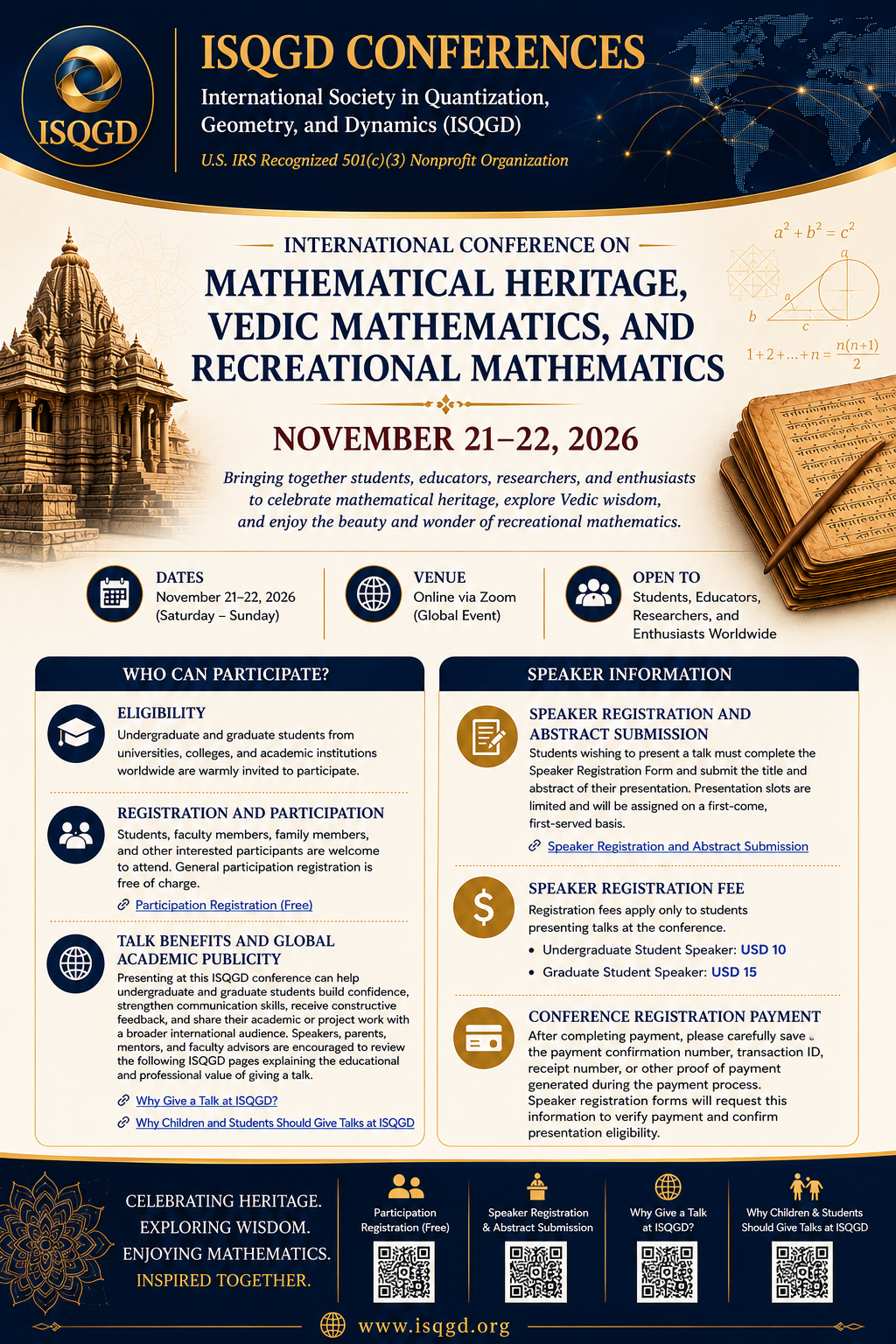
Click the flyer image to view the full-size version.
Conference Theme
The International Conference on Mathematical Heritage, Vedic Mathematics, and Recreational Mathematics provides a global interdisciplinary forum for researchers, educators, historians of mathematics, students, independent scholars, school teachers, mathematics clubs, and mathematics enthusiasts to explore the historical, cultural, educational, and recreational dimensions of mathematics. The conference recognizes mathematics as a shared intellectual heritage of humanity, developed through the contributions of many civilizations and cultures throughout the world. Through three parallel conference tracks— Mathematical Heritage, Vedic Mathematics, and Recreational Mathematics—the conference seeks to promote scholarly research, educational innovation, historical understanding, mathematical creativity, public engagement, and international collaboration.
Track A — Mathematical Heritage
Ancient Egyptian Mathematics; Babylonian Mathematics; Greek Mathematics; Chinese Mathematics; Indian Mathematics; Islamic Mathematics; Medieval European Mathematics; Indigenous and Traditional Mathematical Knowledge; Ethnomathematics; History of Algebra, Geometry, Number Theory, Calculus, Probability and Statistics; Mathematical Manuscripts and Historical Documents; Biographies of Mathematicians; Mathematical Heritage Preservation; Mathematical Culture and Society; Ancient Algorithms; and Cross-Cultural Development of Mathematical Ideas.
Track B — Vedic Mathematics
Vedic Mathematics Sutras and Sub-Sutras; Mental Computation; Rapid Arithmetic Techniques; Computational Thinking; Multiplication and Division Methods; Number Patterns; Classroom Applications; Mathematics Enrichment Programs; Teacher Training; Ancient Indian Mathematics; Sulba Sutras; Contributions of Aryabhata, Brahmagupta, Bhaskara, Madhava, and other historical mathematicians; Educational Research in Vedic Mathematics; and Mathematical Creativity.
Track C — Recreational Mathematics
Mathematical Puzzles; Logic Puzzles; Number Puzzles; Mathematical Games; Magic Squares; Latin Squares; Sudoku and Related Structures; Number Patterns and Curiosities; Kaprekar Numbers; Palindromic Numbers; Figurate Numbers; Recreational Geometry; Mathematical Magic; Mathematical Art; Fractals; Olympiad and Contest Mathematics; Problem Solving Strategies; Mathematical Outreach; and Creative Student Projects.
🎤 Presentation Proposal and Talk Registration by Track
The conference will be conducted through three parallel thematic tracks. Prospective speakers are requested to submit their presentation proposals through the registration form corresponding to the track that best matches the topic of their talk. Interdisciplinary presentations are welcome; in cases where a presentation spans multiple areas, authors should select the track that most closely aligns with the primary focus of the presentation.
Track A — Mathematical Heritage
History of Mathematics, Ancient Mathematics, Mathematical Heritage, Ethnomathematics, Historical Manuscripts, Mathematical Culture, and related topics.
Register for Track ATrack B — Vedic Mathematics
Vedic Mathematics, Mental Computation, Ancient Indian Mathematics, Computational Techniques, Mathematics Education, and related topics.
Register for Track BTrack C — Recreational Mathematics
Mathematical Puzzles, Games, Magic Squares, Number Patterns, Recreational Geometry, Mathematical Outreach, and related topics.
Register for Track CPresentation slots are limited and will be assigned on a first-come, first-served basis. Early registration is strongly encouraged.
Eligibility
University faculty members, school teachers, mathematics educators, researchers, undergraduate and graduate students, K–12 students with suitable projects, mathematics club members, independent scholars, educational practitioners, and mathematics enthusiasts from institutions and communities worldwide are warmly invited to attend as audience members or register as speakers, when eligible.
Audience Attendance and Speaker Registration
Students, faculty members, teachers, parents, family members, mentors, and other interested attendees are welcome to attend the conference as audience members. Audience attendance registration is free of charge. This free registration is for attendees who are not presenting a talk.
🔗 Audience Attendance Registration (Free)
🌍 Talk Benefits and Global Academic Publicity
Presenting at this ISQGD conference can help students, teachers, researchers, independent scholars, and mathematics enthusiasts build confidence, strengthen communication skills, receive constructive feedback, and share their scholarly, educational, historical, cultural, or recreational mathematical work with a broader international audience. Speakers, parents, mentors, teachers, and faculty advisors are encouraged to review the following ISQGD pages explaining the educational and professional value of giving a talk.
🔗
Why Give a Talk at ISQGD?
🔗
Why Children and Students Should Give Talks at ISQGD
Speaker Registration and Abstract Submission
Individuals wishing to present a talk must complete the appropriate track-specific Speaker Registration Form and submit the title and abstract of their presentation. Presentation slots are limited and will be assigned on a first-come, first-served basis. Speakers should select the track that best matches the primary focus of their presentation.
🔗 Please use the Track A, Track B, or Track C speaker registration form listed above under Presentation Proposal and Talk Registration by Track.
Special Speaker Registration Fee — ISQGD–C02
ISQGD has approved a special event-specific speaker registration fee of USD 10 for all eligible speakers for the November 21–22, 2026 ISQGD–C02 conference, regardless of academic category. This special rate replaces the permanent category-based event rates for this conference only.
The USD 10 special speaker registration fee is already reduced. No additional ISQGD Annual Member discount applies to this special rate unless otherwise announced by ISQGD. Audience attendance remains free for individuals who are not presenting a talk.
💳 Pay the ISQGD–C02 Special Speaker Registration Fee — USD 10
The dedicated ISQGD–C02 payment section provides payment options by PayPal and credit/debit card. Please use the event-specific ISQGD–C02 payment option rather than the permanent general event-registration rates.
After completing payment, please carefully save the payment confirmation number, transaction ID, receipt number, or other proof of payment generated during the payment process. Speaker registration forms will request this information to verify payment and confirm presentation eligibility.
Speakers are strongly encouraged to retain a copy of their payment receipt until the conclusion of the conference.
Suggested Areas of Interest
Mathematical Heritage; Ancient Indian Mathematics; Vedic Mathematics; Mental Computation; Recreational Mathematics; Mathematical Puzzles and Games; Magic Squares; Number Patterns; History of Mathematics; Ethnomathematics; Mathematics Education; Teacher Training; Mathematics Enrichment; Student Projects; Mathematical Outreach; and related interdisciplinary topics.
Target Participants
The conference welcomes university faculty members, school teachers, mathematics educators, researchers, undergraduate and graduate students, K–12 students with suitable projects, mathematics club members, independent scholars, educational practitioners, and interested members of the public.
Presentation Format
Speakers may choose either a 15-minute presentation slot or a 30-minute presentation slot, depending on the nature and scope of the talk. The selected time includes the presentation, questions, and answers.
Conference Features
• Invited Talks
• Contributed Presentations
• Educational Demonstrations
• Student and Teacher Presentations
• Mathematical Heritage and History Sessions
• Vedic Mathematics and Mental Computation Sessions
• Recreational Mathematics and Puzzle Sessions
• International Networking Opportunities
• Certificates of Presentation for Registered Speakers
• Publication Opportunities: Registered speakers are encouraged to develop their conference presentations into articles for the following ISQGD publications, whose scopes are closely aligned with the themes of this conference:
- ISQGD Journal of Mathematical Heritage (JMH) — Mathematical Heritage, History of Mathematics, Vedic Mathematics, Mental Computation, Ethnomathematics, and related areas.
- ISQGD Recreational Mathematics Journal (RMJ) — Recreational Mathematics, Mathematical Puzzles, Games, Problem Solving, and Mathematical Explorations.
- ISQGD Bulletin — Expository Articles, Educational Notes, Conference Reports, Project Summaries, and Community News.
Call for Special Session Proposals
The conference welcomes proposals for focused Special Sessions in Mathematical Heritage, Vedic Mathematics, Recreational Mathematics, and closely related educational or interdisciplinary areas. University and college faculty members, researchers, mathematics educators, school teachers, independent scholars, and qualified academic teams are invited to propose sessions that can bring together speakers around a clearly defined theme.
A proposal should include the proposed session title, a concise description of its purpose and scope, the name and affiliation of the organizer or co-organizers, and, when available, a preliminary list of prospective speakers. Approved session organizers will work with the conference leadership to invite speakers and arrange the academic program for their session.
Anyone interested in proposing a Special Session should contact Professor Rakesh Bhatia at rakeshbhatia106@gmail.com.
Conference Organizers
Visiting Faculty, CCS University, Meerut, India
Faculty of Vedic Mathematics, Sir Padampat Singhania Education Centre, Kanpur, India
Department of Mathematics, Principal of Vinoba Bhave University, Hazaribag, Jharkhand, India
Former Professor and Head, Department of Mathematics, Birla Institute of Technology, Mesra, Ranchi, India
Former Faculty Member, BITS Pilani, India
Special Sessions
Approved Special Sessions will be listed here as proposals are reviewed and confirmed.
- Special Session 1: Proposed session title — Organizer or organizing team (to be announced)
- Special Session 2: Proposed session title — Organizer or organizing team (to be announced)
General Conference Inquiries
✉
office@isqgd.org
Date: December 21–23, 2026 (Monday–Wednesday)
Format: Online via Zoom
Official Time Zone: U.S. Central Time (America/Chicago)
Conference Structure: Five Parallel Special Sessions
🌍 Global Scheduling & Time-Zone Coordination
Conference Overview
The International Society for Quality Growth and Development (ISQGD) will organize this three-day international conference in celebration of the 139th birth anniversary of Srinivasa Ramanujan. Centered on December 22, 2026, the anniversary of Ramanujan’s birth, the conference will honor his extraordinary mathematical legacy while providing a broad international forum for current research, exposition, education, and scholarly exchange across major areas of mathematics. Presentations are not required to be directly related to Ramanujan. Ramanujan’s life and work provide the commemorative inspiration for the meeting, while the academic program is intentionally broad so that mathematicians, educators, researchers, and students from diverse fields can participate meaningfully.
Five Parallel Special Sessions
The conference will be organized around five parallel Special Sessions representing broad areas of pure and applied mathematics. Each session welcomes specialized research talks, expository presentations, computational work, and accessible presentations of wider mathematical interest. The research areas listed below are representative rather than exhaustive. Interdisciplinary work is especially encouraged; when a talk overlaps more than one session, speakers should select the session that best reflects the primary mathematical focus of the presentation.
ISQGD–C03–SS20 — Algebra, Number Theory & Discrete Mathematics
Representative research areas include:
Abstract Algebra; Commutative and Noncommutative Algebra; Group Theory; Ring and Field Theory; Representation Theory; Algebraic Geometry; Arithmetic Geometry; Elementary, Algebraic, Analytic, and Computational Number Theory; Diophantine Equations and Diophantine Geometry; Modular Forms; Automorphic Forms; q-Series; Partitions; Continued Fractions; Special Arithmetic Functions; Combinatorics; Enumerative and Algebraic Combinatorics; Graph Theory; Discrete Mathematics; Coding Theory; Cryptography; Discrete Structures; and related areas.
Talks connected with Ramanujan’s mathematics and mathematical legacy, including partitions, modular forms, q-series, mock theta functions, continued fractions, identities, and related topics, are especially welcome.
ISQGD–C03–SS21 — Analysis, Operator Theory & Differential Equations
Representative research areas include:
Real Analysis; Complex Analysis; Functional Analysis; Harmonic Analysis; Fourier Analysis; Operator Theory; Operator Algebras; Spectral Theory; Banach Space Theory; Hilbert Space Methods; Nonlinear Analysis; Approximation Theory; Special Functions; Integral Equations; Calculus of Variations; Ordinary Differential Equations; Partial Differential Equations; Evolution Equations; Functional and Differential Equations; Boundary-Value Problems; Analytic Methods in Mathematical Physics; and related areas.
ISQGD–C03–SS22 — Geometry, Topology & Dynamical Systems
Representative research areas include:
Euclidean and Non-Euclidean Geometry; Differential Geometry; Riemannian and Metric Geometry; Symplectic and Contact Geometry; Hyperbolic Geometry; Geometric Analysis; Algebraic, Geometric, and Differential Topology; Low-Dimensional Topology; Knot Theory; Manifolds; Homotopy and Homology Theory; Geometric Group Theory; Teichmüller Theory; Dynamical Systems; Ergodic Theory; Smooth and Measurable Dynamics; Chaos; Fractal Geometry; Iterated Function Systems; Geometric Measure Theory; and related areas.
ISQGD–C03–SS23 — Applied Mathematics, Optimization & Mathematical Modeling
Representative research areas include:
Applied Mathematics; Linear, Nonlinear, Convex, Discrete, and Global Optimization; Operations Research; Mathematical Programming; Numerical Analysis; Scientific Computing; Computational Mathematics; Numerical Methods for Differential Equations; Control Theory and Optimal Control; Inverse Problems; Mathematical Modeling; Mathematical Biology; Mathematical Physics; Mathematical Finance; Network and Complex Systems; Industrial Mathematics; and interdisciplinary applications.
ISQGD–C03–SS24 — Probability, Statistics & Data Science
Representative research areas include:
Probability Theory; Measure-Theoretic Probability; Stochastic Processes; Stochastic Analysis; Applied Probability; Random Variables and Probability Distributions; Limit Theorems; Markov Chains and Markov Processes; Martingales; Brownian Motion; Stochastic Differential Equations; Random Graphs; Statistical Theory; Mathematical Statistics; Bayesian Statistics; Biostatistics; Time-Series Analysis; Spatial Statistics; Multivariate Analysis; Statistical Modeling; Data Science; Data Analytics; Statistical Learning; Mathematical Foundations of Machine Learning; Uncertainty Quantification; Computational Statistics; and related areas.
Choosing a Special Session: The four sessions are intentionally broad so that researchers from a wide range of mathematical specialties can participate. If a presentation naturally fits more than one session, the speaker may choose the session most closely aligned with the principal methods, results, or applications of the talk. The conference organizers may also recommend a different session when this would improve the academic organization of the program.
Additional Special Session Proposals
ISQGD welcomes proposals for additional Special Sessions that complement the academic scope of the conference. Faculty members, researchers, educators, and other qualified scholars who are interested in organizing a Special Session are invited to contact the ISQGD Office with the proposed session title, a brief description of its scope, and relevant academic information. Please write to office@isqgd.org.
Academic Scope
The conference welcomes presentations across the five parallel Special Sessions listed above, covering a broad spectrum of pure and applied mathematics. Suitable contributions may include original research, expository mathematics, theoretical or computational work, mathematical modeling, educationally valuable mathematical presentations, interdisciplinary applications, and carefully prepared student research or project presentations. The listed research areas are intended as guidance rather than strict boundaries. Contributions related directly to Srinivasa Ramanujan, including number theory, partitions, q-series, modular forms, mock theta functions, continued fractions, special functions, mathematical history, and Ramanujan’s notebooks and legacy, are especially encouraged within the appropriate session.
Speaker Registration and Abstract Submission
Title and Abstract Submission Deadline: November 21, 2026
Faculty members, researchers, postdoctoral scholars, graduate and undergraduate students, educators, independent scholars, and other qualified participants are welcome to register for a presentation and submit the title and abstract of their talk using the Google registration form provided below. Speakers should select the Special Session that best matches the primary focus of their presentation. As presentation slots are limited, early registration is strongly encouraged.
Please select one of the following in the registration form:
- ISQGD–C03–SS20 — Algebra, Number Theory & Discrete Mathematics
- ISQGD–C03–SS21 — Analysis, Operator Theory & Differential Equations
- ISQGD–C03–SS22 — Geometry, Topology & Dynamical Systems
- ISQGD–C03–SS23 — Applied Mathematics, Optimization & Mathematical Modeling
- ISQGD–C03–SS24 — Probability, Statistics & Data Science
Conference Format
The conference will be conducted fully online via Zoom. The academic program will be arranged through the five parallel Special Sessions across the three conference days. The conference schedule will be arranged with consideration for participants joining from different geographical regions and time zones.
Presentation Format
Each speaking slot is 30 minutes — 25 minutes for the presentation, followed by 5 minutes for questions, discussion, and transition to the next talk. All talks will begin at their scheduled times. Speakers are requested to keep within their allotted time so that subsequent talks can start promptly.
Limited Speaking Slots
As the number of speaking slots is limited, interested speakers are strongly encouraged to complete their registration and submit their presentation title and abstract at their earliest convenience, and in all cases before the submission deadline.
Speaker Registration Fees
The permanent ISQGD event rates below apply to eligible individuals presenting talks. Active ISQGD Annual Members receive the 20% discounted rates shown below:
• Primary / Middle / High School Student Speaker: USD 10
• Annual Member — Primary / Middle / High School Student: USD 8
• Undergraduate / Graduate Student / Independent Scholar / Teacher / Lecturer Speaker: USD 15
• Annual Member — Undergraduate / Graduate Student / Independent Scholar / Teacher / Lecturer: USD 12
• Faculty / Postdoctoral Researcher Speaker: USD 20
• Annual Member — Faculty / Postdoctoral Researcher: USD 16
💳 Conference Registration Payment
General Conference Inquiries
✉ office@isqgd.org
Back to top