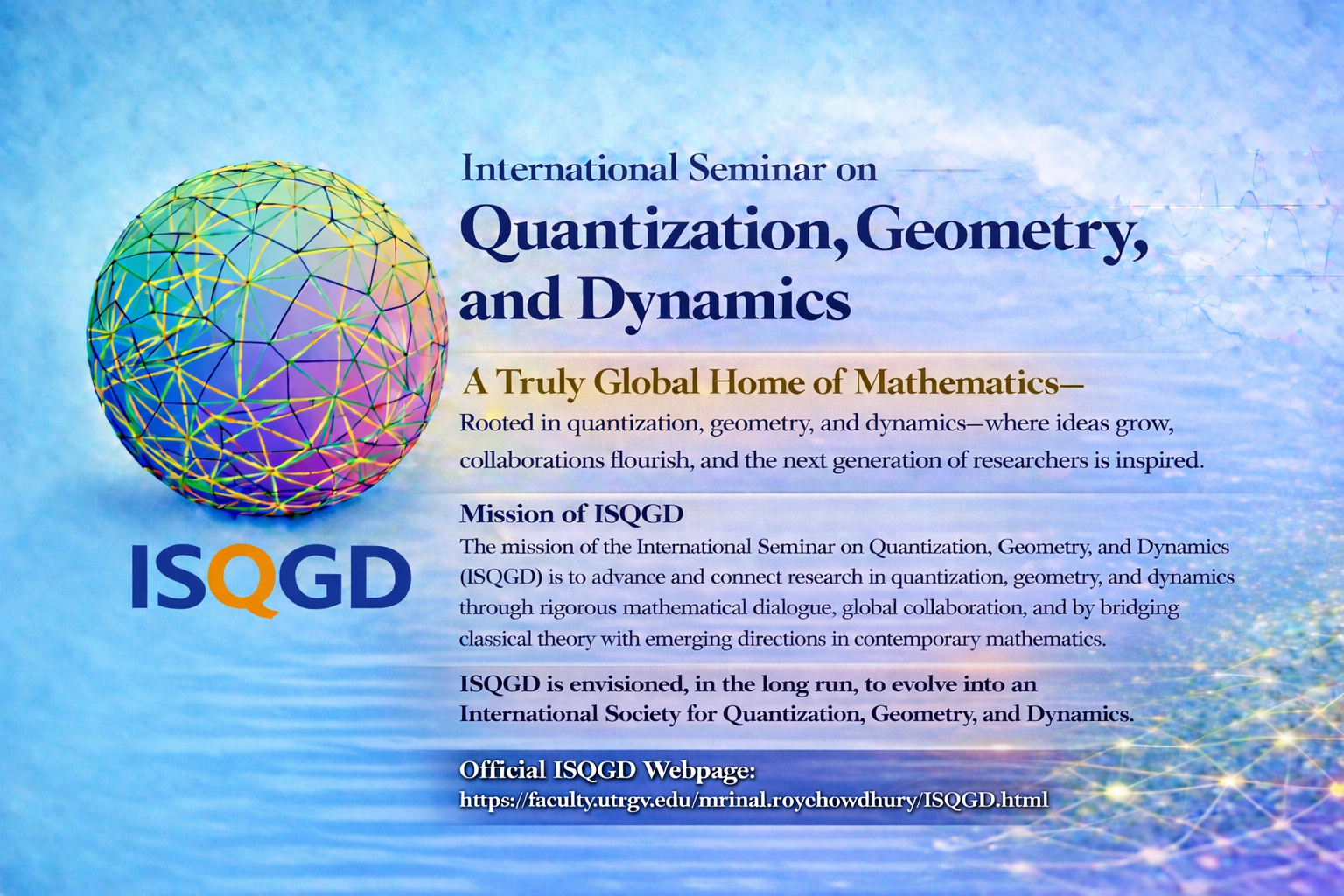
International Society in Quantization, Geometry, and Dynamics (ISQGD) Advancing Mathematics from K–12 Education to Higher Research
International Seminar on Quantization, Geometry, and Dynamics (ISQGD)

About ISQGD

The International Society in Quantization, Geometry, and Dynamics (ISQGD) is a truly global scholarly society devoted to advancing mathematical research, fostering international collaboration, supporting scholarly dissemination, and strengthening educational outreach. Organized exclusively for charitable, educational, and scientific purposes, ISQGD serves both the research community and the broader public by promoting mathematical knowledge, intellectual exchange, and long-term scholarly visibility.

ISQGD is dedicated to advancing research across a broad spectrum of interconnected disciplines within mathematics and their interdisciplinary applications. It brings together researchers working in quantization theory, fractal geometry, topology, dynamical systems, ergodic theory, operator theory, fixed point theory, harmonic and functional analysis, geometric analysis, geometric measure theory, optimal transport, variational methods, geometric optimization, and closely related areas spanning analysis, geometry, probability, computation, and applications, including emerging connections with engineering, data science, and technological innovation.

The International Society in Quantization, Geometry, and Dynamics (ISQGD) advances its charitable, educational, and scientific mission through a collection of scholarly programs designed to support mathematical research, international collaboration, and public mathematical education. These programs create opportunities for researchers, students, educators, and the broader public to participate in meaningful mathematical exchange across institutional and geographic boundaries.

K–12 students, undergraduate and graduate students, early-career researchers, and established scholars alike are welcome to participate in ISQGD programs. As a truly global home of mathematics and interdisciplinary innovation, ISQGD fosters high-level international collaboration, highlights emerging developments, and provides a sustained and professionally organized environment for scholarly exchange among researchers at all career stages.

Some programs focus primarily on advanced research communication and scholarly collaboration, while others extend the Society’s mission to educational outreach and the encouragement of mathematical curiosity among younger learners. Together, these initiatives form an integrated framework through which ISQGD promotes research excellence, intellectual dialogue, and the global dissemination of mathematical knowledge.

The Society’s programs are designed to reflect both its advanced research mission and its broader educational responsibility. Distinguished Lectures, Special Sessions, Workshops, Mini-Courses, conferences, thematic programs, scholarly publications, and public-facing educational initiatives are organized to promote research collaboration and the dissemination of knowledge worldwide. When appropriate, selected presentations are professionally archived through official ISQGD channels to serve as long-term scholarly and educational resources for the global academic community and the broader public.

As an independent international society, ISQGD is guided by a Board of Directors and governing academic leadership composed of distinguished researchers from different regions of the world. This structure supports academic integrity, global inclusiveness, responsible governance, and the long-term development of ISQGD’s scientific, educational, and public-benefit mission.

All programs and initiatives are conducted in furtherance of ISQGD’s charitable, educational, and scientific objectives, subject to academic merit, organizational capacity, and available resources.

Operational Mode of ISQGD

ISQGD operates in a hybrid mode, combining both in-person and remote participation to ensure broad global accessibility while maintaining opportunities for direct academic interaction. ISQGD is not exclusively online; depending on the infrastructure and nature of each event, activities may be organized fully on site, fully remote, or in a blended format connecting physical venues with a worldwide virtual audience.

This flexible operational structure enables researchers from diverse regions and academic environments to participate meaningfully in Distinguished Lectures, Special Sessions, Workshops, Mini-Courses, conferences, and collaborative discussions, while also supporting broader educational and public-facing initiatives when appropriate. In this way, ISQGD advances its mission to promote inclusive, dynamic, and globally connected mathematical exchange.

Researchers interested in presenting their work or proposing academic activities are warmly encouraged to contact the relevant session organizers or members of the ISQGD academic leadership.

Vision & Structure of ISQGD

Global framework, organizational development, and long-term institutional sustainability

The International Society in Quantization, Geometry, and Dynamics (ISQGD) is guided by a clear global vision and an evolving organizational framework designed to advance its charitable, educational, and scientific mission. As a truly global home of mathematics and interdisciplinary innovation, ISQGD fosters international collaboration, scholarly exchange, sustained academic development, and broader educational engagement across diverse regions of the world. The Society is conceived as a globally connected scholarly institution rather than a locally centered organization.

While the physical head office of ISQGD is planned to be established in Houston — one of the most internationally connected cities in the United States — the Society operates through a hybrid international model that enables worldwide participation. Alongside the Houston headquarters, ISQGD continues to develop virtual offices and operational nodes across different regions, promoting inclusive engagement and coordinated academic, educational, and outreach activities under a unified governance structure.

As ISQGD grows and its permanent office infrastructure develops, the Society anticipates strengthening its professional operational framework through appropriate administrative and technical support roles. These developments reflect ISQGD’s long-term commitment to building a sustainable, globally connected academic platform dedicated exclusively to advancing research, education, scholarly dissemination, and public-benefit outreach for the international academic community and wider society.

Long-Term Sustainability and Academic Growth

Building upon its global organizational framework, ISQGD is committed to advancing its charitable, educational, and scientific mission through long-term academic sustainability, responsible development, and inclusive international collaboration. As a truly global home of mathematics and interdisciplinary innovation, the Society seeks to cultivate a stable and enduring platform where researchers in quantization, geometry, dynamics, and related mathematical sciences can exchange ideas, disseminate knowledge, and advance interdisciplinary dialogue.

To maintain continuity, academic integrity, and professional standards, ISQGD emphasizes transparent governance, community engagement, and responsible stewardship of resources. Support from the global academic community contributes to sustaining reliable digital infrastructure, long-term scholarly archival initiatives, administrative coordination, and the organization of Distinguished Lectures, Special Sessions, Workshops, Mini-Courses, conferences, mentoring programs, and appropriate educational outreach activities, all conducted exclusively in furtherance of ISQGD’s nonprofit objectives.

ISQGD Official Notices

This section provides important society-wide notices and operational policies relevant to ISQGD academic activities. Information is updated as needed to maintain clarity, transparency, and consistency across programs conducted in furtherance of ISQGD’s charitable, educational, and scientific mission.

Recording & Archiving Policy

For documentation and long-term scholarly record-keeping, ISQGD talks are recorded using the official ISQGD Zoom cloud recording. Discussion sessions are never recorded. Public posting of recordings (for example, on the ISQGD YouTube channel) is subject to the speaker’s preference; if a speaker requests that a recording not be posted publicly, it will not be made publicly available.

ISQGD maintains a professional archival record of its academic activities through official session pages and related archives, ensuring long-term visibility and accessibility of talks when speakers permit public sharing, consistent with its educational and scientific objectives.

Participation Certificates

Upon request, ISQGD may issue official participation certificates to speakers for academic and professional purposes. Certificates are generated through the official ISQGD system and correspond to documented program records and archived session pages, in alignment with the Society’s nonprofit mission.

Supporting ISQGD’s Academic Mission

As a nonprofit global academic society organized exclusively for charitable, educational, and scientific purposes, ISQGD advances its mission through the collective engagement of its international research community. Voluntary contributions from individuals and institutions help sustain professional standards, strengthen global accessibility, and support the long-term scholarly activities of the International Society in Quantization, Geometry, and Dynamics (ISQGD).

Contributions are used solely to advance the Society’s exempt educational and scientific purposes. These include maintaining reliable digital infrastructure, producing high-quality lecture recordings, preserving professionally curated long-term research archives, and organizing ISQGD academic programs such as Distinguished Lectures, Workshops, Special Sessions, Mini-Courses, conferences, mentoring opportunities for students and early-career researchers, and broader mathematics outreach initiatives. Even modest support plays a meaningful role in sustaining ISQGD’s global educational and scientific activities.

🔗
Support the educational and research activities of ISQGD:
Support ISQGD
Research Areas and Core Pillars of ISQGD

In furtherance of its charitable, educational, and scientific mission, ISQGD advances research across a broad spectrum of areas centered on quantization, geometry, and dynamics, together with their deep theoretical foundations and interdisciplinary applications. As a truly global home of mathematics and interdisciplinary innovation, the society welcomes scholarly contributions that promote rigorous analysis, conceptual development, and meaningful connections across mathematical sciences. Talks are welcome in, but not limited to, the following areas:

  1. Quantization Theory

    Quantization Theory is a central theme within the intellectual scope of the international society in Quantization, Geometry, and Dynamics. It encompasses both classical and modern mathematical approaches to quantization arising in applied mathematics, geometry, analysis, probability, and mathematical physics.

    In applied mathematical quantization, the subject includes constrained and unconstrained quantization problems; the study of optimal n-means for continuous, discrete, singular, and self-similar distributions; and detailed investigations of quantization error, including error analysis, high-resolution asymptotics, convergence rates, and stability results. It also involves the study of quantization dimension, quantization coefficients, and their relationships with local dimension and other geometric characteristics of measures and sets.

    Quantization problems arise naturally on a wide variety of spaces, including Euclidean spaces, Riemannian manifolds, spherical surfaces, fractal sets, and other nonlinear metric spaces. Research in this area includes geometric, variational, and algorithmic methods for computing optimal quantization sets, as well as extensions of quantization theory to graphs, networks, and combinatorial metric structures.

    In geometric and analytic approaches to quantization in mathematical physics, the subject includes geometric quantization of symplectic manifolds and related structures, including the study of prequantum line bundles, polarizations, and the correspondence between classical observables and quantum operators. Closely related directions include deformation quantization through star products, Poisson brackets, and formal deformations of commutative algebras of observables.

    Further developments include stochastic quantization based on Langevin dynamics and path-integral formulations of quantum field theories. Additional related frameworks include phase-space quantization, Berezin–Toeplitz quantization methods, and operator-algebraic perspectives that link classical phase-space geometry with noncommutative quantum structures.

  2. Fractal Geometry

    Self-similar, self-affine, and random fractal sets; Moran constructions, generalized Moran structures, and iterated function systems (IFS) with or without overlap; fractal functions, fractal interpolation schemes, and IFS-generated curves and surfaces; classical and generalized dimensions (Hausdorff, packing, box-counting, Assouad, and lower dimensions); multifractal analysis and spectrum theory for measures and dynamical quantities; fractal boundaries, attractors, invariant sets, Julia sets, and limit sets; fractal geometry on manifolds, spheres, and curved surfaces; and applications to dynamical systems, geometric structures, optimization, and measure-theoretic modeling.

  3. Topology

    Topological spaces and structures arising in quantization, geometry, and dynamical systems; general topology of metric and topological spaces, including compactness, connectedness, continuity, convergence, and completeness; low-dimensional and geometric topology, including knot theory, link theory, and embeddings of curves and graphs in manifolds, with connections to dynamical systems, geometry, and mathematical physics; topological manifolds and spaces appearing in geometric, fractal, and dynamical settings; topological and symbolic dynamics, shift spaces, subshifts of finite type, and coding of dynamical systems; invariant sets, attractors, limit sets, orbit closures, recurrence, and minimality; topological entropy, conjugacy, semi-conjugacy, and structural stability; Cantor-type sets and totally disconnected spaces; topological dimension theory and its relationships with Hausdorff, packing, box-counting, and other fractal dimensions; topology of self-similar, self-affine, and dynamically defined sets; graph, network, and combinatorial topology; topological constraints and stability phenomena in constrained and conditional quantization; and connections with shape theory, inverse limits, persistent homology, and topological data analysis, with applications to variational problems, optimal transport, and quantization on nonlinear and singular spaces.

  4. Dynamical Systems

    Uniformly, partially, and non-uniformly hyperbolic systems; symbolic dynamics, Markov partitions, and subshifts; thermodynamic formalism including pressure, equilibrium states, Gibbs measures, and large deviation principles; invariant sets, attractors, limit sets, Lyapunov exponents, entropy, and stability theory; chaotic dynamics, mixing, robustness, and quantum and semiclassical aspects of dynamical systems (quantum chaos); and random, parametric, and skew-product systems.

    The area also includes infinite-dimensional dynamical systems generated by partial differential equations, including fluid-dynamical flows, with focus on invariant structures, attractors, mixing, and ergodic properties.

    The scope further encompasses conformal and complex dynamics, including rational, meromorphic, and entire maps; Julia and Fatou sets; rational and transcendental semigroups; conformal graph-directed systems; dimension theory for conformal and holomorphic iterated function systems; and the thermodynamic and fractal properties of complex and random holomorphic dynamical systems.

  5. Ergodic Theory

    Ergodic measures, invariant transformations, and ergodic decompositions; unique ergodicity, rigidity phenomena, and classification of invariant measures; mixing, weak mixing, strong mixing, and decay of correlations; metric and topological entropy, recurrence theory, and orbit distributions; applications to quantization, information theory, and geometric measure structures; and connections with number theory, Diophantine approximation, and dynamical systems on homogeneous and arithmetic spaces.

  6. Operator Theory

    Linear and nonlinear operators on Banach and Hilbert spaces; bounded, compact, and self-adjoint operators; spectral theory and spectral geometry, including eigenvalue problems, spectral asymptotics, spectral measures, resonances, and inverse spectral questions; functional calculus, semigroups of operators, and generator theory; C*-algebras, von Neumann algebras, and noncommutative geometric methods in dynamics and geometry; transfer operators, Perron–Frobenius and Koopman operators arising in ergodic theory and dynamical systems; operator-theoretic methods in quantization, including spectral decompositions, compactness and stability properties, and operator-valued metrics; Laplacians, Schrödinger-type operators, and differential operators on manifolds, graphs, quantum graphs, and fractal sets; and applications to geometric analysis, harmonic analysis, complex dynamics, and mathematical physics.

  7. Fixed Point Theory

    Classical and modern fixed point theorems, including Banach, Schauder, Brouwer, Kakutani, Browder, and Krasnosel’skii-type results; fixed points of linear and nonlinear operators, multivalued maps, and nonexpansive mappings on Banach, Hilbert, and general metric spaces; contraction principles and generalized fixed point frameworks in metric and topological settings; invariant points and equilibrium states in dynamical systems, iterated function systems, and random and parametric processes; fixed points of transfer operators, Perron–Frobenius operators, and Markov operators arising in ergodic theory and thermodynamic formalism; applications to fractal geometry, self-similarity, and attractor theory; fixed point methods in variational problems, evolution equations, and partial differential equations; and connections with quantization, optimal transport, geometric optimization, and stability theory.

  8. Harmonic Analysis

    Harmonic analysis studies the representation of functions, operators, and signals through oscillatory components, Fourier-analytic methods, and spectral decompositions. It plays a central role in modern analysis and interacts deeply with geometry, operator theory, probability, dynamics, partial differential equations, and data science.

    Harmonic Analysis on Fractals and Metric Spaces

    Analysis on non-smooth and irregular structures such as fractals, graphs, networks, and general metric-measure spaces; Fourier and wavelet analysis on self-similar and self-affine sets; frames, sampling theory, and multiresolution and multiscale constructions; spectral properties of Laplacians and related operators; heat kernel methods and diffusion processes; and applications to signal analysis, image processing, and data representation on complex geometric structures.

    Harmonic Analysis and Convex Geometry

    Fourier-analytic methods in convex geometry, including geometric and functional inequalities, Brunn–Minkowski theory, restriction phenomena with geometric content, and connections with geometric measure theory, probability, and high-dimensional convexity.

    Harmonic Analysis and Operator Theory

    Operator-theoretic methods in harmonic analysis, including singular integrals, pseudodifferential operators, Calderón–Zygmund theory, multiplier operators, functional calculi, and spectral techniques, with applications to partial differential equations, dynamics, quantization, and mathematical physics.

    Harmonic Analysis on Manifolds and Lie Groups

    Harmonic analysis on manifolds, Lie groups, and homogeneous spaces, including representation theory, non-Euclidean Fourier analysis, invariant differential operators, heat kernels, and eigenfunction expansions, with strong links to geometry, topology, and mathematical physics.

    Spectral Theory, Frames, and Sampling

    Spectral analysis of operators and spaces; eigenvalue problems and spectral decompositions; frame theory, sampling and reconstruction, wavelets, multiresolution analysis, and stability questions in Euclidean and non-Euclidean settings.

    Applications to Dynamics, PDEs, and Data Science

    Applications of harmonic-analytic techniques to dynamical systems, ergodic theory, and partial differential equations, as well as modern applications to signal processing, image analysis, learning theory, and data representation on complex geometric and multiscale structures.

  9. Functional Analysis (Foundations and Infinite-Dimensional Analysis)

    Banach and Hilbert space theory; locally convex spaces; weak, strong, and weak-* topologies; compactness, reflexivity, and duality methods; infinite-dimensional analysis; variational and convex-analytic frameworks; functional-analytic foundations underlying quantization, ergodic theory, and thermodynamic formalism; operator semigroups and evolution equations from a functional-analytic perspective; and interactions with infinite-dimensional dynamical systems, diffusion processes, and analysis on metric-measure and fractal spaces.

  10. Geometric Analysis

    Geometric analysis on smooth manifolds, including Riemannian and metric geometry; curvature-dependent geometric PDEs and variational problems; classical and sharp geometric inequalities with applications to quantization and optimization; Laplace–Beltrami operators, semiclassical and microlocal analysis, eigenvalue problems, and geometric spectral theory; structure and analysis of measure and metric-measure spaces; and spherical geometry involving small circles, spherical polygons, geodesic configurations, and geometric optimization on curved surfaces.

  11. Geometric Measure Theory

    Rectifiable and unrectifiable sets, geometric densities, and Hausdorff measures; projection theorems, slicing techniques, and dimension theory; measure-theoretic and geometric foundations of fractals, invariant sets, and dynamical systems; and applications to quantization, geometric approximation, and optimization on irregular, singular, or fractal geometric spaces.

  12. Optimal Transport

    Wasserstein distances (Wp), optimal transport maps, and Kantorovich formulations; transport-based approaches to quantization, clustering, and geometric approximation; geometric, analytic, and dynamical applications of optimal transport; gradient flows and evolution equations in Wasserstein spaces; transport and functional inequalities, including Talagrand, HWI, and logarithmic Sobolev inequalities; curvature-dimension conditions and displacement convexity; and metric-measure structures and geometric analysis arising from optimal transport theory.

  13. Variational Methods

    Variational principles underlying quantization, geometric partitioning, and energy-based optimization; minimization of geometric and analytic energies on Euclidean spaces, manifolds, and fractal domains; classical and modern tools from the calculus of variations, including Euler–Lagrange equations, variational inequalities, and geometric functionals; nonlocal variational models, peridynamics, and nonlocal continuum mechanics; discrete-to-continuum limits, Γ-convergence, and asymptotic analysis for local and nonlocal energies; and deep connections with elliptic and geometric partial differential equations, optimal transport, and geometric optimization on curved, singular, and irregular spaces.

  14. Geometric Optimization

    Centroidal Voronoi tessellations (CVTs) and optimal tessellations; energy-minimizing and equilibrium configurations on Euclidean domains, manifolds, and curved surfaces; sphere packing, covering, and best-packing problems; geometric coding theory, spherical designs, and optimal spherical codes; optimal partitions and quantization on geometric and metric-measure spaces; and applications to geometric approximation and optimization on curved and non-Euclidean surfaces.

  15. Probability Theory and Stochastic Processes

    Stochastic processes and random walks on manifolds, graphs, and fractal spaces; Markov chains, Markov processes, and random dynamical systems; Brownian motion and diffusions on irregular geometries; stochastic differential equations and stochastic flows; probabilistic potential theory and martingale methods in dimension theory; and random constructions in fractals, invariant measures, and quantization.

  16. Computational Mathematics and Numerical Methods

    Numerical algorithms for optimal quantization, clustering, and geometric approximation; simulation and computation of dynamical systems, fractal structures, and geometric flows; numerical schemes for partial differential equations and variational problems on manifolds, metric spaces, and irregular domains; numerical analysis and simulation of nonlocal and peridynamic models, including multiscale, adaptive, and nonlocal discretization techniques; high-performance and large-scale computing for geometric, dynamical, and stochastic models; and discrete and computational approaches to spectral problems, energy minimization, inverse problems, and optimal transport.

  17. Machine Learning, AI Geometry, and Data Science (Mathematical Foundations)

    Vector quantizers, prototype-based models, and clustering algorithms; geometric and manifold-based learning; Wasserstein and transport-based methods in data science; fractal and multiscale features in learning and signal analysis; mathematical foundations of geometric deep learning and representation learning; and rigorous links between quantization, statistical learning theory, and modern data-driven methods.

  18. Mathematical Physics and Discrete Energy Models

    Minimal-energy particle systems and Coulomb/Riesz-type interactions; discrete energies and equilibrium configurations on manifolds, spheres, graphs, and fractal sets; quantum and semiclassical models with geometric, spectral, or fractal structure; Schrödinger operators, quantum graphs, and spectral geometry; Gibbs states, free energy minimization, phase transitions, and quantum ergodicity; and statistical-mechanical frameworks involving potentials, equilibrium distributions, and thermodynamic limits with geometric or dynamical features.

  19. Information Geometry and Statistical Mechanics

    Divergences and information-theoretic distances (including α-divergences, Rényi and Tsallis entropies, and Bregman-type divergences); statistical manifolds, Fisher information metrics, and information-geometric flows; entropy-based variational principles and free energy functionals; gradient flows and evolution equations in spaces of probability measures; and connections with optimal transport, thermodynamic formalism, and equilibrium states in dynamical systems and quantization.

  20. Applications and Interdisciplinary Directions

    Applications in data compression, signal processing, and information theory; machine-learning methods including vector quantizers, clustering algorithms, and prototype-based models; numerical approximation and discretization techniques on manifolds and geometric domains; geometric modeling, mesh generation, and computer graphics; mathematical physics involving minimal-energy particle systems, Coulomb/Riesz interactions, and discrete energies; and statistical-mechanical frameworks involving free energy, potentials, and equilibrium distributions.

  21. Additional and Emerging Research Directions

    1. Nonlocal Models and Peridynamics.
      Nonlocal diffusion and interaction models; nonlocal variational formulations and peridynamics; discrete-to-continuum limits and convergence analysis; numerical and analytical methods for nonlocal operators; and applications to materials science, continuum mechanics, fracture modeling, and multiscale geometric structures.
    2. Dimension Theory and Multiscale Geometry.
      Dimension theory across geometry, dynamics, probability, and fractals; dimension spectra for measures and invariant sets; multiscale geometric analysis; and rigidity and stability phenomena.
    3. Metric Geometry and Analysis on Metric Spaces.
      Gromov–Hausdorff convergence; analysis on metric-measure spaces; curvature notions in nonsmooth settings; and applications to quantization and optimal transport.
    4. Random and Stochastic Geometry.
      Random geometric structures; Poisson point processes; random graphs and tessellations; stochastic geometry on manifolds and fractals; and probabilistic quantization methods.
    5. Discrete Geometry and Discrete Dynamical Systems.
      Combinatorial geometry; graph dynamics; cellular automata; and energy minimization and quantization on discrete structures.
    6. Inverse Problems and Geometric Reconstruction.
      Inverse problems on geometric and fractal domains; reconstruction from quantized or noisy data; stability and identifiability; and applications to imaging and data analysis.
    7. Partial Differential Equations on Irregular Domains.
      PDEs on fractals and singular spaces; heat, wave, and diffusion equations; spectral and variational aspects; and interactions with operator theory and harmonic analysis.
    8. Mathematical Foundations of Scientific Computing.
      Convergence and stability of numerical schemes; quantization-based discretization; and theoretical aspects of computation in geometry and dynamics.
    9. Mathematical Biology, Networks, and Complex Systems.
      Dynamical systems and networks in biological and complex systems; geometric and probabilistic modeling; quantization and clustering methods; and large-scale interacting systems.
    10. Spectral, Semiclassical, and Scaling Phenomena.
      Spectral asymptotics; semiclassical limits; renormalization and scaling methods; multifractal spectra of measures and eigenfunctions; spectral optimization and shape optimization; and interfaces between spectra, geometry, and dynamics.

    The above list is not exhaustive; ISQGD warmly welcomes contributions at the interfaces of these areas, as well as new and emerging directions aligned with its mission.

ISQGD Logo Meaning

To learn about the mathematical symbolism and conceptual significance of the ISQGD Logo, please click the button below.

Logo Meaning

This page explains the ideas behind the design of the ISQGD logo, including the mathematical operators, the geometric network structure, and the global symbolism representing the mission of the International Society in Quantization, Geometry, and Dynamics (ISQGD).

Academic Programs and Educational Initiatives

The International Society in Quantization, Geometry, and Dynamics (ISQGD) advances its charitable, educational, and scientific mission through a collection of scholarly programs designed to support mathematical research, international collaboration, and public mathematical education. These programs create opportunities for researchers, students, educators, and the broader public to participate in meaningful mathematical exchange across institutional and geographic boundaries.

Some programs focus primarily on advanced research communication and scholarly collaboration, while others extend the Society’s mission to educational outreach and the encouragement of mathematical curiosity among younger learners. Together, these initiatives form an integrated framework through which ISQGD promotes research excellence, intellectual dialogue, and the global dissemination of mathematical knowledge.

1. ISQGD Distinguished Lecture Series

The ISQGD Distinguished Lecture Series is one of the Society’s principal flagship programs. It is intended to bring internationally recognized mathematicians, scientists, and distinguished scholars to present lectures on significant developments in quantization, geometry, dynamics, harmonic analysis, fractal geometry, probability, mathematical physics, and related areas of modern mathematics and interdisciplinary science.

These lectures are designed not only to share advanced research but also to create a global scholarly environment in which mathematicians from different countries, backgrounds, and research traditions can engage with one another. The program provides a platform for high-level intellectual exchange and contributes to the long-term academic identity of ISQGD as a worldwide home for serious mathematical dialogue.

Each Distinguished Lecture typically features a leading scholar whose work has had substantial influence in a major area of research. Through this program, ISQGD offers faculty members, postdoctoral researchers, graduate students, and advanced participants the opportunity to interact with prominent voices in the international mathematical community.

In addition to the live academic event, the Distinguished Lecture Series contributes to long-term scholarly visibility through professional archiving. When appropriate, lectures may be recorded and preserved through the official ISQGD archive so that they remain accessible for future educational and scholarly benefit.

Main features:
  • Lectures by internationally respected scholars and leading researchers
  • Global participation through remote or hybrid academic access
  • Promotion of deep research dialogue across mathematical disciplines
  • Long-term archiving for continued educational and scholarly use
  • Strengthening of ISQGD’s academic visibility and international reputation

2. ISQGD Special Sessions

ISQGD Special Sessions are focused academic programs organized around specific themes, research directions, or interdisciplinary topics of contemporary interest. These sessions usually bring together a selected group of invited speakers whose work is connected by a common mathematical theme or by a shared scientific direction.

The purpose of a Special Session is to create a structured research forum within which participants can explore a topic in a concentrated and collaborative way. Such sessions allow ISQGD to highlight emerging developments, support thematic research communities, and create opportunities for specialists to interact with researchers from neighboring fields.

A Special Session may focus on a classical field with renewed importance, a rapidly developing frontier area, or a topic that naturally connects mathematics with engineering, data science, technology, or the applied sciences. Because of their flexible format, Special Sessions can respond quickly to important developments in the mathematical sciences while maintaining high academic standards.

These sessions also create meaningful opportunities for academic networking, collaboration, and future program development. In many cases, they help build long-term research connections among scholars who may later collaborate on workshops, publications, conferences, or educational initiatives.

Main features:
  • Thematic scholarly focus around a particular research area
  • Invited speakers from multiple institutions and countries
  • Flexible format suitable for concentrated academic exchange
  • Support for collaboration, visibility, and interdisciplinary discussion
  • Opportunities for both established scholars and emerging researchers

3. ISQGD Workshops

ISQGD Workshops are designed to provide deeper and more sustained academic engagement than a single lecture or short session. Workshops may include lecture series, mini-courses, problem-oriented presentations, collaborative discussions, reading activities, or research-focused interactions centered on a specific topic or group of related themes.

The workshop format allows participants to spend more time exploring foundational ideas, technical methods, emerging applications, and unresolved questions. This makes workshops particularly valuable for building understanding, encouraging collaboration, and promoting meaningful exchange between senior researchers, early-career scholars, and students.

Depending on the subject, an ISQGD Workshop may be theoretical, interdisciplinary, pedagogical, or exploratory in character. Some workshops may focus on highly advanced research questions, while others may be organized in a way that helps participants enter a developing area of study through structured exposition and discussion.

Workshops are also an effective way for ISQGD to support sustained intellectual communities and to create an environment in which participants can interact in a more extended and collaborative manner than is usually possible in shorter events.

Main features:
  • In-depth exploration of specific mathematical or interdisciplinary topics
  • Possible inclusion of mini-courses, collaborative sessions, and extended discussions
  • Support for research development and conceptual understanding
  • Meaningful interaction across career stages and institutions
  • Flexible format for advanced, emerging, or cross-disciplinary themes

4. ISQGD Mini-Courses

ISQGD Mini-Courses are structured instructional programs designed to introduce participants to important mathematical theories, emerging research directions, and advanced methodological tools through a sequence of coordinated lectures. Unlike a single research lecture, a mini-course provides a systematic introduction to a topic and develops its core ideas over multiple sessions.

These courses are typically taught by leading researchers who present foundational concepts, major results, and modern developments in a clear and pedagogically structured format. Mini-courses are particularly valuable for graduate students, early-career researchers, and mathematicians wishing to enter a new research area.

Through the Mini-Course program, ISQGD seeks to promote deeper understanding of contemporary mathematical research areas while helping participants build the background necessary for further study and collaboration.

Educational Purpose

The purpose of ISQGD Mini-Courses is to bridge the gap between introductory exposure and advanced research by presenting mathematical topics in a coherent sequence of lectures. Participants gain insight into both conceptual foundations and current research perspectives.

Typical Structure

A mini-course may consist of several lectures delivered over multiple sessions. The lectures are usually organized in a progressive format, beginning with fundamental ideas and gradually moving toward deeper theoretical results or current research problems.

  • Series of coordinated lectures on a focused mathematical topic
  • Development of concepts from foundational ideas to advanced applications
  • Introduction to modern research directions and open problems
  • Opportunities for discussion and interaction with the instructor
  • Suitable for graduate students, early-career researchers, and interested scholars

Possible Topics

Mini-courses may cover a wide range of subjects related to the scientific scope of ISQGD, including but not limited to:

  • Quantization and mathematical physics
  • Geometry and geometric analysis
  • Dynamical systems and ergodic theory
  • Harmonic analysis and operator theory
  • Fractal geometry and stochastic processes
  • Mathematical methods in data science and applied sciences

Scholarly Value

By providing a structured introduction to advanced topics, ISQGD Mini-Courses help participants develop the conceptual background needed to engage with current research literature. They also serve as an important educational bridge between graduate-level study and active research.

Whenever appropriate, mini-course lectures may be recorded and archived in the ISQGD educational repository, allowing the broader mathematical community to benefit from these instructional resources.

5. ISQGD Mathematics Outreach Program (K–12)

The ISQGD Mathematics Outreach Program (K–12) is a major educational initiative through which the Society extends its mission beyond the research community and into the wider world of school mathematics and public education. Although ISQGD is fundamentally a global research society, it also recognizes that the long-term health of mathematics depends on inspiring younger learners, supporting teachers, and helping the public appreciate the intellectual and cultural value of mathematical thinking.

This program is intended to promote interest in mathematics among school students from kindergarten through grade 12, while also creating enrichment opportunities for teachers, parents, and educational communities. The outreach program seeks to present mathematics not merely as a collection of school procedures, but as a living field of ideas involving beauty, structure, reasoning, creativity, discovery, and connection to the natural and scientific world.

Through this initiative, ISQGD may help students encounter mathematics in a more inspiring and meaningful way. Students may be introduced to topics such as patterns, geometry, symmetry, infinity, fractals, combinatorics, logical reasoning, mathematical games, cryptography, chaos, mathematical modeling, and the role of mathematics in science and technology. The goal is to help young learners see mathematics as a subject that invites exploration and imagination.

Educational Purpose

The educational purpose of the K–12 Outreach Program is to foster curiosity, confidence, creativity, and analytical thinking among school students, while also supporting the broader educational ecosystem in which mathematics learning takes place. ISQGD may contribute by creating accessible opportunities for students to engage with authentic mathematical ideas and by helping teachers connect school mathematics with deeper conceptual understanding.

Principal Goals

  • To inspire students to appreciate mathematics as a creative, beautiful, and intellectually rich discipline
  • To provide enrichment beyond the standard classroom curriculum
  • To support mathematical curiosity and independent thinking among young learners
  • To assist teachers through professional development and conceptual enrichment
  • To promote public understanding of mathematics as part of culture, science, and human knowledge
  • To expand ISQGD’s public educational mission through accessible and globally inclusive programs

Possible Components of the Program

1. Global Online Outreach Lectures
ISQGD may organize accessible online talks for school students in which mathematicians present fascinating mathematical ideas in a clear and inspiring way. Such lectures may introduce students to geometry in nature, mathematical patterns, fractals, symmetry, logic, codes, probability, or the use of mathematics in science and engineering. These talks may be live or recorded and may be made available as public educational resources through the ISQGD website.

2. Teacher Enrichment and Professional Development
ISQGD may support K–12 teachers by organizing workshops or enrichment sessions that strengthen conceptual understanding, connect school mathematics with broader mathematical ideas, and introduce creative teaching approaches. These sessions may help teachers experience mathematics from a research-informed perspective while remaining attentive to classroom relevance.

3. Student Enrichment Activities
The program may include enrichment sessions in which students explore puzzles, patterns, logical challenges, and mathematical investigations beyond routine textbook exercises. These activities are intended to encourage perseverance, inquiry, and joy in mathematical exploration.

4. Public Educational Resources
ISQGD may develop and share educational resources such as short essays, recorded mini-lectures, problem collections, activity sheets, reading lists, and introductory explanations of beautiful mathematical topics. These materials may be designed for students, teachers, families, and the general public.

5. School and Community Collaboration
ISQGD may collaborate with schools, teachers, universities, educational nonprofits, outreach groups, and community programs in order to broaden access to mathematical enrichment and public mathematics activities.

6. Mentoring and Encouragement of Talented Students
Where feasible, ISQGD may support mentoring opportunities for mathematically interested students by connecting them with educators, graduate students, or research mathematicians who can encourage further study and exploration.

Guiding Philosophy

ISQGD’s approach to K–12 outreach is rooted in the belief that mathematics should be experienced as a field of ideas rather than only as a sequence of required school techniques. The program therefore emphasizes curiosity, conceptual understanding, creative problem solving, discussion, and wonder. It is not limited to competition preparation or curriculum tutoring. Instead, it seeks to open a door into the deeper spirit of mathematics.

Long-Term Vision

In the long term, the ISQGD Mathematics Outreach Program may become a global platform for public mathematics education, helping to identify and encourage young talent, support teachers, broaden mathematical literacy, and strengthen appreciation for mathematics across many communities and countries. It also has the potential to serve as an important bridge between the advanced research culture of ISQGD and the educational needs of future generations.

6. ISQGD Global Math Circles

The ISQGD Global Math Circles initiative is a specialized educational program designed to create an engaging, collaborative, and intellectually welcoming environment in which students can explore mathematics through guided discovery and creative problem solving. A math circle is different from a standard classroom lesson. Rather than emphasizing routine instruction or test preparation, a math circle encourages students to investigate interesting questions, share ideas, discover patterns, and learn how mathematicians think.

ISQGD Global Math Circles may bring together school students, teachers, graduate students, early-career researchers, and professional mathematicians in a community of mathematical exploration. Because ISQGD is an international society, these math circles may be organized in online or hybrid form, making it possible for students from different regions of the world to participate together.

This program is especially valuable for students who are curious about mathematics and want a richer experience than what is always available in a regular school setting. It may also benefit students who enjoy puzzles and patterns, those who are beginning to think more deeply about problem solving, and those who may eventually wish to pursue mathematics, science, engineering, or related disciplines.

Educational Philosophy of Math Circles

The philosophy of a math circle is that students learn mathematics most deeply when they actively participate in exploration. In this setting, students are not expected merely to imitate a demonstrated procedure. Instead, they are invited to ask questions, test examples, make conjectures, compare strategies, explain their reasoning, and experience the excitement of genuine mathematical discovery.

The atmosphere of a math circle is collaborative rather than competitive, exploratory rather than mechanical, and intellectually serious while still welcoming and enjoyable. This makes math circles particularly effective in helping students develop confidence, independence, persistence, and mathematical imagination.

Core Features of ISQGD Global Math Circles

  • Collaborative problem solving: Students work on interesting problems together and are encouraged to discuss multiple approaches.
  • Guidance from mathematicians and mentors: Sessions may be led by mathematicians, graduate students, or trained facilitators who guide exploration without reducing the experience to rote instruction.
  • Rich but accessible topics: Topics may include number theory, combinatorics, geometry, patterns, graph ideas, logic, puzzles, mathematical games, and introductory proof-oriented reasoning.
  • Global participation: Online and hybrid formats make it possible to connect students across countries and educational systems.
  • Discovery-centered learning: Students are encouraged to notice structure, formulate ideas, and communicate mathematical reasoning.

Possible Structure of a Session

A typical ISQGD Global Math Circle session may begin with a carefully chosen puzzle, pattern, or thought-provoking question. Students may then work individually or in groups to test examples, search for structure, and develop ideas. Facilitators may guide the discussion by asking clarifying questions, suggesting new perspectives, or helping students compare different approaches.

The session may conclude with a collective discussion in which students present their observations, explain their reasoning, and reflect on what they discovered. The goal is not simply to obtain the correct answer, but to understand why the ideas work and to appreciate the elegance of mathematical thinking.

Possible session elements:
  • Opening puzzle, visual pattern, or intriguing mathematical question
  • Guided exploration by students individually or in groups
  • Collaborative discussion of methods and observations
  • Student explanation and presentation of ideas
  • Reflection and encouragement for continued curiosity beyond the session

Benefits for Students

Through regular participation, students may develop habits of careful reasoning, persistence, communication, and creative thought. They may also gain a more positive and confident relationship with mathematics. For many students, math circles provide their first experience of mathematics as an exploratory and communal activity rather than as a purely formal school subject.

Over time, ISQGD Global Math Circles may also help identify and encourage mathematically talented students, support learners who may not have local enrichment opportunities, and create a sense of belonging within an international mathematical community.

Long-Term Vision

The long-term vision of ISQGD Global Math Circles is to build a globally connected culture of mathematical curiosity among young learners. By linking students with mathematicians and mentors across borders, the program can help cultivate future researchers, scientists, teachers, and mathematically literate citizens while also reflecting ISQGD’s broader mission of worldwide scholarly engagement and educational benefit.

Conclusion

Through these programs, ISQGD advances its identity as a global research society while also extending its educational impact to wider communities. Its academic initiatives support research excellence, international scholarly dialogue, and long-term intellectual visibility, while its educational and outreach initiatives help inspire future generations and strengthen public appreciation of mathematics.

Together, these programs reflect the Society’s commitment to research, education, outreach, and global mathematical culture.

Message from the Founding Chair, ISQGD

The vision of the international society in Quantization, Geometry, and Dynamics (ISQGD) is to cultivate a truly global scholarly community in which meaningful mathematical and interdisciplinary exchange can flourish across continents, traditions, and research cultures. Mathematical progress grows not only from individual insight, but also from sustained dialogue, shared exploration, and the collective pursuit of deeper understanding. Organized exclusively for charitable, educational, and scientific purposes, ISQGD was founded to embody and advance these values, fostering connections that enrich both the theoretical foundations of mathematics and their broader scientific and interdisciplinary applications.

True leadership is realized not only in leading, but in nurturing future leaders who will uphold and advance the legacy of ideas.

As an independent international society, ISQGD serves as a permanent framework for scholarly interaction, collaboration, and academic leadership in quantization, geometry, dynamics, and related mathematical sciences, together with their natural connections to engineering, data science, technology, and the applied sciences. This guiding purpose shapes how our activities are designed, organized, and sustained—through Distinguished Lectures, Special Sessions, Workshops, Mini-Courses, conferences, and related initiatives that connect researchers worldwide and support the dissemination of knowledge across disciplinary boundaries.

At the same time, ISQGD recognizes that the long-term vitality of mathematics depends not only on advanced research but also on inspiring the next generation of thinkers. Through educational outreach initiatives, including programs for K–12 students, teachers, and emerging learners, the Society seeks to encourage curiosity, creativity, and appreciation for mathematical ideas at the earliest stages of learning while building pathways toward deeper academic engagement.

ISQGD’s academic leadership, together with its session organizers, is committed to fostering an environment in which researchers, educators, and students—from young learners exploring mathematics for the first time to established scholars contributing to frontier research—can engage in thoughtful exchange, explore new perspectives, and develop lasting professional connections. We strive to maintain an academic program that is inclusive, intellectually vibrant, and professionally structured, welcoming participation from individuals across the global mathematical community at every stage of their intellectual journey.

The continued growth of ISQGD is made possible by the dedication and enthusiasm of its speakers, participants, educators, and supporters around the world. It is our aspiration that ISQGD will continue to flourish, stimulate productive collaborations, inspire thematic workshops and educational initiatives, and contribute meaningfully to the advancement of mathematics, science, and public understanding for many years to come.

— Dr. Mrinal K. Roychowdhury
Founding Chair, ISQGD

Registration

Registration with the international society in Quantization, Geometry, and Dynamics (ISQGD) provides access to official announcements, Distinguished Lectures, Special Sessions, Workshops, and other hybrid academic activities organized under the ISQGD umbrella. Registered participants receive essential event information, including schedules, Zoom access details, and updates concerning ongoing and upcoming ISQGD programs.

Register for ISQGD Unsubscribe

If you experience any difficulty registering or unsubscribing, please contact: mrinal.roychowdhury@isqgd.org.

ISQGD Distinguished Lecture Series

The ISQGD Distinguished Lecture Series features invited talks by distinguished researchers and emerging leaders from around the world. These lectures highlight important developments in areas related to quantization, geometry, dynamics, analysis, and interdisciplinary mathematical sciences.

Detailed information about current and upcoming ISQGD Distinguished Lectures, including speaker affiliations, lecture titles, abstracts, schedules, and Zoom meeting links for participation, is available on the dedicated lecture page below.

View Current & Upcoming Distinguished Lectures

Through this series, the International Society in Quantization, Geometry, and Dynamics (ISQGD) provides a global forum for the presentation and discussion of significant mathematical ideas and advances.

ISQGD Special Sessions

ISQGD Special Sessions bring together researchers working on focused themes in mathematics and related disciplines. These sessions provide a platform for the presentation of recent research results, collaborative discussion, and the exploration of emerging directions across areas connected to quantization, geometry, dynamics, analysis, and interdisciplinary mathematical sciences.

Detailed information about current and upcoming ISQGD Special Sessions, including session themes, organizers, speakers, lecture titles, abstracts, schedules, and Zoom meeting links for participation, is available on the dedicated page below.

View Current & Upcoming Special Sessions

Through these thematic sessions, the International Society in Quantization, Geometry, and Dynamics (ISQGD) encourages international collaboration and provides opportunities for researchers to exchange ideas, present new developments, and engage with the global mathematical community.

ISQGD Workshops

ISQGD Workshops are intensive research meetings designed to promote collaboration, discussion of open problems, and cross-fertilization of ideas among experts, postdoctoral researchers, and graduate students. These workshops focus on active areas of research related to quantization, geometry, dynamics, analysis, and interdisciplinary mathematical sciences.

Detailed information about current and upcoming ISQGD Workshops, including workshop themes, organizers, speakers, lecture titles, abstracts, schedules, and Zoom meeting links for participation, is available on the dedicated workshops page below.

View Current & Upcoming Workshops

Through these workshops, the International Society in Quantization, Geometry, and Dynamics (ISQGD) provides a collaborative environment for researchers to exchange ideas, present recent advances, and explore emerging directions in mathematical science.

ISQGD Mini-Courses

ISQGD Mini-Courses are structured lecture series designed to introduce important mathematical ideas in a clear and systematic way. These mini-courses typically consist of a sequence of lectures that present fundamental concepts together with modern perspectives in mathematical research.

Topics may include areas related to quantization, geometry, dynamics, and other areas of contemporary mathematical science. Detailed information about current and upcoming ISQGD Mini-Courses, including instructors, lecture titles, schedules, and Zoom meeting links for participation, is available on the dedicated mini-courses page below.

View Current & Upcoming Mini-Courses

Through these mini-courses, the International Society in Quantization, Geometry, and Dynamics (ISQGD) provides structured learning opportunities that help students and researchers build strong foundations while exploring active directions in modern mathematical science.

ISQGD Archive (Past Events & Activities)

The ISQGD Archive serves as the official record of past activities of the International Society in Quantization, Geometry, and Dynamics (ISQGD). It provides a structured collection of previously held lectures, special sessions, workshops, mini-courses, and other academic events organized by the Society.

Each archived event typically includes information such as the speaker, lecture title, abstract, date, and links to slides or video recordings. Through this archive, participants and visitors can revisit past presentations and explore the wide range of mathematical topics discussed in ISQGD programs.

View ISQGD Archive

The archive reflects ISQGD’s commitment to open academic exchange and long-term preservation of scholarly talks, allowing researchers, students, and the broader community to access presentations and discussions from ISQGD events worldwide.

ISQGD YouTube Channel

The ISQGD YouTube Channel serves as the official media archive of the International Society in Quantization, Geometry, and Dynamics (ISQGD). It hosts recordings of ISQGD Distinguished Lectures, workshops, special sessions, mini-courses, and other academic events.

Through this channel, ISQGD provides global access to high-level research talks in quantization, geometry, dynamics, and related areas of mathematics and mathematical physics. Scholars, students, and researchers from around the world can freely access these recordings and benefit from the international mathematical dialogue fostered by the Society.

Visit the ISQGD YouTube Channel

The channel continues to grow as ISQGD organizes new events and lectures, building a long-term open archive of mathematical presentations accessible to the global research community.

ISQGD Associate Secretaries

ISQGD Board of Directors

(Official Governing Body of ISQGD)

Executive Officers

Professor Mrinal Kanti Roychowdhury (Founding Chair, ISQGD)
School of Mathematics and Statistical Sciences, UTRGV, USA
mrinal.roychowdhury@utrgv.edu
Professor Palle Jorgensen (President, ISQGD)
Department of Mathematics, University of Iowa, USA
palle-jorgensen@uiowa.edu
Professor Carlo Cattani (Vice-Chair, ISQGD)

Engineering School (DEIM), University of Tuscia, Italy
cattani@unitus.it
Professor Jasang Yoon (Secretary, ISQGD)
School of Mathematics and Statistical Sciences, UTRGV, USA
jasang.yoon@utrgv.edu
Professor Christian Wolf (Treasurer, ISQGD)
Department of Mathematics and Statistics, Mississippi State University, USA
CWolf@math.msstate.edu

Board Directors

01. Professor Haci Mehmet Baskonus
Professor of Mathematics
Faculty of Education, Harran University, Sanliurfa, Turkey
hmbaskonus@gmail.com
02. Professor Binayak Samadder Choudhury
Department of Mathematics, Indian Institute of Engineering Science and Technology (IIEST), Shibpur, India
binayak@math.iiests.ac.in
03. Professor Stefano Galatolo
Department of Mathematics, Università di Pisa, Italy
stefano.galatolo@unipi.it
04. Professor Eleftherios Gkioulekas
School of Mathematics and Statistical Sciences, UTRGV, USA
eleftherios.gkioulekas@utrgv.edu
05. Professor Yonatan Gutman
Institute of Mathematics of the Polish Academy of Sciences, Poland
gutman@impan.pl
06. Professor Zhiming Li
Northwest University, Xi’an, Shaanxi Province, China
china-lizhiming@163.com
07. Professor John C. Mayer
Department of Mathematics, University of Alabama at Birmingham, USA
jcmayer@uab.edu
08. Professor Radu MICULESCU
Faculty of Mathematics and Informatics, Transilvania University of Braşov, Romania
radu.miculescu@unitbv.ro
09. Professor Ram N. Mohapatra
Professor of Mathematics (Retired)
University of Central Florida, Orlando, FL 32816, USA
ram.mohapatra@ucf.edu
10. Professor María A. Navascués
Department of Applied Mathematics, Universidad de Zaragoza, Spain
manavas@unizar.es
11. Professor Isaia Nisoli
Department of Mathematics, Institute of Mathematics Federal University of Rio de Janeiro (UFRJ), Brazil
nisoli@im.ufrj.br
12. Professor Lars Olsen
School of Mathematics and Statistics, University of St Andrews, UK
lo@st-andrews.ac.uk
13. Professor William Ott
Department of Mathematics, University of Houston, USA
william.ott.math@gmail.com
14. Professor Maria Alessandra Ragusa
Department of Mathematics and Computer Science, University of Catania, Italy
mariaalessandra.ragusa@unict.it
15. Professor Karin Reinhold
Department of Mathematics & Statistics, University at Albany, SUNY, USA
reinhold@albany.edu
16. Professor Yuzuru Sato
RIES / Department of Mathematics, Hokkaido University, Japan
ysato@math.sci.hokudai.ac.jp
17. Professor Patrick D. Shipman
Department of Mathematics, The University of Arizona, USA
patrickshipman@arizona.edu
18. Professor Cesar E. Silva
Department of Mathematics, Williams College, USA
csilva@williams.edu
19. Professor Nandor Simanyi
Department of Mathematics, University of Alabama at Birmingham, USA
simanyi@uab.edu
20. Professor Tanmoy Som
Department of Mathematical Sciences, Indian Institute of Technology (BHU), India
tsom.apm@iitbhu.ac.in
21. Professor Anita Tomar
Department of Mathematics, Sridev Suman Uttarakhand University, India
anitatmr@yahoo.com
22. Professor Mariusz Urbański
Department of Mathematics, University of North Texas, USA
urbanski@unt.edu
23. Professor Francesco Villecco
Department of Industrial Engineering, University of Salerno, Italy
fvillecco@unisa.it

Support ISQGD — Sponsorship & Contributions

The international society in Quantization, Geometry, and Dynamics (ISQGD) is an independent nonprofit international society organized exclusively for charitable, educational, and scientific purposes. ISQGD is dedicated to advancing mathematics and interdisciplinary research while also promoting mathematical learning and outreach across all educational levels — from K–12 education to advanced research. The Society fosters scholarly exchange, collaboration, and academic engagement among researchers, educators, and students worldwide. All ISQGD activities are professionally organized with a strong emphasis on academic quality, accessibility, integrity, and long-term sustainability.

ISQGD operates as a community-driven international society. Through its hybrid format, ISQGD enables researchers, educators, and students worldwide to participate and collaborate without the usual barriers of visas, travel, or significant funding constraints. In addition to research programs, ISQGD also promotes educational initiatives, mentoring opportunities, and outreach activities that help cultivate interest in mathematics among younger learners and support the next generation of scientists. To ensure that ISQGD remains reliable, professionally organized, and broadly accessible, voluntary support from individuals and institutions plays an important role.

Your support directly strengthens
  • Distinguished Lectures and regular ISQGD talks by leading researchers
  • Thematic Special Sessions, Workshops, Conferences, and Mini-Courses
  • Educational outreach initiatives connecting mathematics from K–12 to higher research
  • Mentoring and participation opportunities for students and early-career researchers
  • Robust technical infrastructure supporting large international audiences
  • Time-zone-friendly programming connecting participants across continents
  • High-quality recordings and professionally maintained long-term scholarly archives

Contributions

If you value open, high-quality mathematical exchange, global collaboration, and educational outreach in mathematics, you are warmly invited to contribute. Contributions are voluntary and are used solely to support ISQGD’s charitable, educational, and scientific programs. Even modest support helps ensure that ISQGD remains accessible, professionally managed, and sustainable.

🔗 Support ISQGD — Contribute (secure giving form)

Sponsorship Opportunities

Individuals, departments, institutes, foundations, and organizations may also choose to sponsor an ISQGD academic activity, such as a Special Session, Workshop, Mini-Course, Distinguished Lecture, educational outreach program, or mathematics enrichment initiative. Sponsorship helps strengthen ISQGD’s technical capacity, expand programming, and maintain broad global accessibility.

With the sponsor’s permission, sponsorship may be acknowledged on the event webpage, in announcements, and alongside archived materials. Any acknowledgment is purely informational, does not constitute advertising, and is presented in a manner consistent with ISQGD’s academic mission and nonprofit status.

Academic independence: Sponsorship does not imply endorsement, advertising, or influence over scholarly content, speaker selection, editorial policies, or program decisions. ISQGD retains full academic and organizational independence in all of its activities.

We are sincerely grateful for every form of support—financial, organizational, and advisory—that helps ISQGD grow as a sustainable, professionally structured, and globally connected scholarly society advancing mathematics from K–12 education to higher research.

Contact

For general inquiries, participation, collaboration opportunities, or sponsorship and donation matters, please contact:

Dr. Mrinal Kanti Roychowdhury
Founding Chair & Board Director
International Society in Quantization, Geometry, and Dynamics (ISQGD)
Professor of Mathematics, UTRGV, USA

Head Office: Houston, Texas, USA

📞 Phone (Call): +1 346-775-5886

💬 Messaging: SMS / Text Message / WhatsApp

💬 WhatsApp: Message ISQGD via WhatsApp

Email: mrinal.roychowdhury@isqgd.org

🌍 Website: ISQGD — https://www.isqgd.org/