Official Publication of ISQGD

ISQGD Bulletin

Official Bulletin of the International Society in Quantization, Geometry, and Dynamics

Volume 1 • Issue 1

May 2026

Advancing Mathematics from K–12 Education to Higher Research

Publication Information

Essential publication details for citation, correspondence, and future indexing.
Title
ISQGD Bulletin
Issue
Volume 1, Issue 1 — May 2026
Publisher
International Society in Quantization, Geometry, and Dynamics (ISQGD)
Publication Frequency
Quarterly
ISSN
To be assigned
Editorial Correspondence
mrinal.roychowdhury@isqgd.org
Website
🌍 https://www.isqgd.org/
Suggested Citation
ISQGD Bulletin, Volume 1, Issue 1, International Society in Quantization, Geometry, and Dynamics, May 2026.
Future DOI-ready note. Persistent identifiers such as DOI and ISSN may be added in future issues as the Bulletin expands its indexing and archival infrastructure.

Message from the Founding Chair

A welcome note for the inaugural issue of the Bulletin.

It is my great pleasure to present the inaugural issue of the ISQGD Bulletin, the official publication of the International Society in Quantization, Geometry, and Dynamics.

This Bulletin reflects our vision of creating a truly global academic platform that connects mathematics across all levels—from K–12 education to advanced research. It is designed not only to disseminate knowledge but also to inspire curiosity, foster collaboration, and highlight the unity and beauty of mathematical thought.

Through this initiative, ISQGD seeks to cultivate a vibrant international community in which students, educators, researchers, and interdisciplinary scholars can engage with mathematics in meaningful and accessible ways while advancing scholarship at the highest level.

We warmly invite contributions from around the world and encourage our readers to participate actively in future issues of the Bulletin.

Dr. Mrinal Kanti Roychowdhury
Founding Chair & Board Director, ISQGD
Professor of Mathematics
The University of Texas Rio Grande Valley (UTRGV), USA

Aims & Scope

The scholarly mission and editorial vision of the ISQGD Bulletin.

The ISQGD Bulletin is an international scholarly publication dedicated to advancing mathematics across all levels, from foundational education to cutting-edge research.

The Bulletin serves as a platform for:

  • Feature articles of broad mathematical and intellectual interest,
  • news and opportunities relevant to the mathematical community,
  • K–12 level mathematical enrichment and educational outreach,
  • undergraduate and graduate level expository articles,
  • research and expository contributions, and
  • mathematics education and outreach activities across diverse communities.

Emphasizing clarity, accessibility, intellectual depth, and interdisciplinary relevance, the Bulletin reflects the mission of ISQGD as a global research society committed to scholarly excellence and meaningful mathematical communication.

Submission Guidelines

General guidance for contributors to future issues of the Bulletin.

Suggested Length

  • Short Announcements: 100–300 words (approximately 1/4–1 page)
  • News and Opportunity Notes: 150–500 words (approximately 1/2–1 page)
  • K–12 and Educational Articles: 500–3000 words (approximately 1–6 pages)
  • Undergraduate & Graduate Level Articles: 1000–5000 words (approximately 2–10 pages)
  • Research & Expository Articles: 2000–5000 words (approximately 4–10 pages)
  • Feature Articles: 2000–6000 words (approximately 4–12 pages; subject to editorial approval)

Page estimates are based on the ISQGD Bulletin format and may vary depending on figures, equations, and layout.

Manuscripts and editorial correspondence:
mrinal.roychowdhury@isqgd.org

Editorial Board

Editorial leadership of the Bulletin and its international scholarly direction.

The ISQGD Bulletin is the official publication of the international society in Quantization, Geometry, and Dynamics. The editorial board reflects the global and interdisciplinary vision of ISQGD.

Editor-in-Chief

Dr. Mrinal Kanti Roychowdhury
School of Mathematical and Statistical Sciences
The University of Texas Rio Grande Valley (UTRGV), USA
mrinal.roychowdhury@utrgv.edu

Managing Editor

Dr. Karin Reinhold Larsson
Department of Mathematics & Statistics
University at Albany, SUNY, USA
reinhold@albany.edu

Section Editors

Editorial responsibilities organized by the six principal sections of the Bulletin.

Section Editors oversee contributions within specific thematic areas of the Bulletin, ensuring quality, coherence, and alignment with the academic vision of ISQGD.

1. Feature Article

Editor:

  • Dr. Mrinal Kanti Roychowdhury
    School of Mathematical and Statistical Sciences
    The University of Texas Rio Grande Valley (UTRGV), USA
    mrinal.roychowdhury@utrgv.edu

2. News & Opportunities

Editors:

3. K-12 Level Articles

Editors:

  • Ms. Richa Jain (PhD Scholar & Assistant Professor)
    Government College Chhapara, District Seoni,
    Raja Shankar Shah University, Madhya Pradesh, India
    richajain8797@gmail.com
  • Dr. Sourav Bhattacharya
    National Institute of Technology, Nagpur, India
    sourav9221@gmail.com

4. Undergraduate & Graduate Level Articles

Editors:

5. Research & Expository Articles

Editors:

  • Dr. Mujahid Abbas
    University of Johannesburg, South Africa
    mujahida@uj.ac.za
  • Dr. Carlo Cattani
    Engineering School (DEIM), University of Tuscia, Italy
    cattani@unitus.it
  • Dr. Mrinal Kanti Roychowdhury
    School of Mathematical and Statistical Sciences
    The University of Texas Rio Grande Valley (UTRGV), USA
    mrinal.roychowdhury@utrgv.edu

6. Mathematics Education & Outreach

Editors:

7. Community Forum

Editors:

Contents

Navigate quickly to each major section and its articles.

Click any entry below to jump directly to a section or article. The Bulletin is designed as an interactive document so that readers may move easily between the table of contents and individual contributions.

Select a section below to explore the Bulletin.

Feature Article

Invited contribution for this issue.

The feature article of this inaugural issue reflects the central vision of the Bulletin: to present mathematics as a creative, evolving, and deeply interconnected discipline, spanning ideas from early curiosity to advanced research.

The Beauty of Mathematical Thinking: From Curiosity to Discovery

Abstract. Mathematics is often perceived as a subject of formulas, rules, and procedures. However, at its heart, mathematics is a creative and dynamic human endeavor driven by curiosity, pattern recognition, and logical reasoning. In this article, we explore the beauty of mathematical thinking, emphasizing how it develops from simple observations to deep theoretical insights. We discuss how mathematical ideas evolve across different levels—from K–12 education to advanced research—and highlight the unifying role of structure, abstraction, and imagination.

Reading note. Use the buttons below to view or download the article. You may return to the contents page at any time.

Full Article (PDF)

The complete feature article is available in polished PDF format for reading, downloading, and archival reference.

News and Opportunities

Reports, announcements, opportunities, and highlights from ISQGD and the broader mathematical community.

This section presents recent developments, institutional highlights, and academic opportunities within ISQGD and the broader mathematical community, reflecting the Society’s ongoing commitment to research, collaboration, communication, and outreach.

Society Reports & Highlights

The following reports document major academic and organizational developments within ISQGD, including executive appointments, long-term institutional planning, lecture series, special sessions, and workshops.

ISQGD Executive Officers

In a significant milestone for the organizational development of the International Society in Quantization, Geometry, and Dynamics (ISQGD), the Society successfully conducted its executive appointments in March 2026. These appointments reflect ISQGD’s continued commitment to academic excellence, strong governance, and global collaboration.

The following distinguished scholars have been elected to serve as Executive Officers of ISQGD:

  • Professor Palle Jorgensen — President, ISQGD
    Department of Mathematics, University of Iowa, USA
    palle-jorgensen@uiowa.edu
  • Professor Carlo Cattani — Vice-Chair, ISQGD
    Engineering School (DEIM), University of Tuscia, Italy
    cattani@unitus.it
  • Professor Jasang Yoon — Secretary, ISQGD
    School of Mathematics and Statistical Sciences, UTRGV, USA
    jasang.yoon@utrgv.edu
  • Professor Christian Wolf — Treasurer, ISQGD
    Department of Mathematics and Statistics, Mississippi State University, USA
    CWolf@math.msstate.edu

The Society continues under the visionary leadership of its Founding Chair, Dr. Mrinal Kanti Roychowdhury (Professor of Mathematics, The University of Texas Rio Grande Valley, Texas, USA), whose dedication has been instrumental in establishing ISQGD as a truly global home of mathematics and interdisciplinary innovation, spanning activities from K–12 outreach to advanced research.

The Society warmly congratulates the newly elected officers and looks forward to their leadership in advancing the mission and global impact of ISQGD.

Next: The Vision: ISQGD Academic Center ↓

The Vision: ISQGD Academic Center

As part of its long-term vision and institutional development, the International Society in Quantization, Geometry, and Dynamics (ISQGD) is actively working toward establishing a permanent headquarters in Houston, Texas, USA—the ISQGD Academic Center. This center is envisioned as a global hub for mathematical research, interdisciplinary collaboration, scholarly exchange, and educational outreach.

The ISQGD Academic Center will provide a unified and dynamic framework supporting a wide range of academic and educational activities, including international conferences, workshops, special sessions, mini-courses, mentoring initiatives, and K–12 outreach programs. Through these efforts, the Center will play a central role in strengthening ISQGD’s global presence and advancing its mission of promoting mathematics from foundational education to advanced research.

A central and forward-looking component of this initiative is the development of a dedicated Artificial Intelligence (AI) Research Facility. This facility is envisioned as a multidisciplinary environment where mathematical theory, scientific innovation, and emerging technologies intersect. It will support research on the mathematical foundations of artificial intelligence, the development of advanced computational methods, and the application of intelligent systems to contemporary scientific challenges.

By fostering deep connections between mathematics and modern technological advancements, the ISQGD Academic Center aims to create a vibrant ecosystem for discovery, learning, and global collaboration—serving researchers, educators, and students across all levels.

↑ Previous | Next: Distinguished Lecture Series ↓

ISQGD Distinguished Lecture Series: Fifteen Lectures from December 2025 to April 2026

From December 5, 2025 to April 17, 2026, the International Society in Quantization, Geometry, and Dynamics (ISQGD) successfully organized fifteen distinguished lectures under the ISQGD Distinguished Lecture Series. This remarkable sequence of lectures brought together internationally recognized scholars working in diverse areas of mathematics, including quantization, geometry, dynamical systems, harmonic analysis, fractal geometry, operator theory, and related interdisciplinary fields.

The series was designed to promote high-level mathematical communication while creating a truly global platform for the exchange of ideas. Through these lectures, ISQGD offered researchers, faculty members, postdoctoral scholars, graduate students, and enthusiastic learners around the world an opportunity to engage with contemporary mathematical research in an accessible, professional, and interactive setting.

The successful organization of these fifteen lectures within a relatively short period reflects the strong academic vision of ISQGD and its commitment to advancing mathematics from broad educational outreach to higher research. It also demonstrates the society’s dedication to fostering international collaboration, scholarly excellence, and the long-term dissemination of mathematical knowledge.

An especially valuable feature of this lecture series is its permanent public accessibility. All lectures are available for public viewing through the ISQGD YouTube Channel, making this growing collection a lasting academic resource for the global mathematical community. In addition, all Distinguished Lectures can be conveniently explored through the official archive page: ISQGD Archive, where detailed records, including lecture titles and related information, are systematically organized.

The following distinguished speakers delivered lectures in the series:

  • ISQGD–DL15 — Sascha Troscheit — April 17, 2026
  • ISQGD–DL14 — Wuchen Li — April 3, 2026
  • ISQGD–DL13 — Lars Olsen — March 27, 2026
  • ISQGD–DL12 — Zhiqiang Wang — March 13, 2026
  • ISQGD–DL11 — Kenneth M. Golden — March 6, 2026
  • ISQGD–DL10 — Kenneth Falconer — February 27, 2026
  • ISQGD–DL09 — Christian Wolf — February 20, 2026
  • ISQGD–DL08 — Károly Simon — February 13, 2026
  • ISQGD–DL07 — William O'Regan — February 6, 2026
  • ISQGD–DL06 — Patrick D. Shipman — January 30, 2026
  • ISQGD–DL05 — Jonathan Fraser — January 23, 2026
  • ISQGD–DL04 — Stefano Galatolo — January 16, 2026
  • ISQGD–DL03 — Balázs Bárány — December 19, 2025
  • ISQGD–DL02 — Peter Massopust — December 12, 2025
  • ISQGD–DL01 — Palle Jorgensen — December 5, 2025

Together, these lectures form an important part of the early academic record of ISQGD and highlight the society’s emerging role as a vibrant international center for mathematical research, communication, and collaboration. With this continuing momentum, ISQGD looks forward to expanding the Distinguished Lecture Series further and strengthening its position as one of the leading global organizations dedicated to mathematics and interdisciplinary innovation.

↑ Previous | Next: Special Sessions ↓

ISQGD Special Sessions: Highlights (February – April 2026)

From February 14 to April 12, 2026, the International Society in Quantization, Geometry, and Dynamics (ISQGD) successfully organized seven (7) Special Sessions covering a broad spectrum of contemporary topics in mathematics. These sessions brought together researchers and scholars from across the world, fostering active discussion, collaboration, and exchange of ideas in both theoretical and applied directions.

The Special Sessions were carefully structured to highlight emerging developments in areas such as fractal geometry, harmonic analysis, operator theory, dynamical systems, and manifold analysis. Each session featured a series of invited talks presented in a professional yet accessible format, encouraging participation from a global audience of researchers, faculty members, and students.

In alignment with ISQGD’s commitment to long-term academic dissemination, most of the talks— subject to speakers’ permission—have been recorded and are available through the ISQGD YouTube Channel. In addition, all sessions can be conveniently explored through the official archive page: ISQGD Archive.

The Special Sessions conducted during this period are listed below:

  • April 11–12, 2026ISQGD–SS05 — Functional Analysis and Operator Theory
  • April 11–12, 2026ISQGD–SS12 — Modern Trends in Fractal Geometry
  • March 21–22, 2026ISQGD–SS14 — Ergodic Theory and Topological Dynamics
  • March 14–15, 2026ISQGD–SS04 — Analysis on Manifolds
  • March 7–8, 2026ISQGD–SS03 — Use of Harmonic Analysis in Quantization, Geometry, and Dynamics
  • February 21–22, 2026ISQGD–SS02 — Fractal Interpolation and Iterated Function Systems
  • February 14–15, 2026ISQGD–SS01 — Fractal Geometry and Dynamical Systems

These Special Sessions represent an important component of ISQGD’s academic activities and demonstrate the society’s ongoing commitment to fostering high-quality mathematical research, interdisciplinary collaboration, and global scholarly engagement. With continued momentum, ISQGD aims to further expand its Special Session programs and strengthen its role as a leading international platform for mathematical sciences.

↑ Previous | Next: Workshop ↓

ISQGD Workshop: Fractal Geometry (February 28, 2026)

On February 28, 2026, the International Society in Quantization, Geometry, and Dynamics (ISQGD) successfully organized its workshop ISQGD–WS01 — Workshop on Fractal Geometry. This workshop brought together researchers, educators, and students from around the world, creating a vibrant environment for the exchange of ideas and recent developments in fractal geometry.

The workshop reflects ISQGD’s broader commitment to fostering mathematical communication, supporting scholarly collaboration, and providing meaningful learning opportunities across different levels of engagement.

↑ Previous

Academic Opportunities

Call for Contributions to Future Issues of the ISQGD Bulletin

Contributions are warmly invited for future issues of the ISQGD Bulletin. The Bulletin welcomes feature articles, mathematical news items, K–12 level articles, undergraduate and graduate level expository articles, research and expository papers, and mathematics education and outreach contributions.

Authors may submit polished HTML-ready or PDF-ready material depending on the nature of the article. Mathematical exposition, visual clarity, and accessibility are especially encouraged.

K-12 Level Articles

Accessible and inspiring mathematical articles for school-level learners, teachers, and families.

This section presents articles written for young learners and classroom enrichment. The emphasis is on clarity, curiosity, visual thinking, and mathematical beauty.

Vedic Mathematics: A Beautiful Art of Mental Calculation

Abstract. Vedic Mathematics is a collection of elegant techniques for performing arithmetic quickly and efficiently. Popularized by Bharati Krishna Tirthaji, these methods emphasize mental calculation, pattern recognition, and simplicity. This article introduces a few key ideas from Vedic Mathematics in a manner accessible to K--12 students, illustrating how mathematics can be both powerful and enjoyable.

Next: Undergraduate & Graduate Level Articles ↓

Undergraduate & Graduate Level Articles

Expository articles for readers seeking deeper conceptual understanding and mathematical maturity.

These articles provide deeper mathematical exposition suitable for undergraduate and graduate readers. They emphasize conceptual clarity, rigor, and structured presentation, while remaining accessible to a broad mathematical audience.

Undergraduate Expository Articles

This section is intended for articles that bridge classroom mathematics and deeper conceptual exposition. Typical topics may include calculus, linear algebra, abstract algebra, real analysis, geometry, combinatorics, probability, and related fields written with pedagogical care.

Graduate-Level Expository Articles

This section is intended for graduate-level articles that present advanced mathematical ideas clearly, while still remaining readable to non-specialists with appropriate background. Articles may include surveys, thematic expositions, and conceptual introductions to modern areas.

↑ Previous | Next: Research & Expository Articles ↓

Research & Expository Articles

Accessible research articles, scholarly notes, expositions, and hybrid HTML/PDF contributions.

This section presents concise mathematical articles, short expository contributions, focused scholarly notes, and selected PDF-based articles.

Research and Expository Contributions

Research and expository articles in this section may include original mathematical notes, carefully written expositions, survey-style essays, and focused introductions to specialized topics relevant to quantization, geometry, dynamical systems, fractal analysis, harmonic analysis, operator theory, and related areas.

Editorial Perspective

Articles in this section should balance mathematical substance with readability. Authors are encouraged to include motivating discussion, examples, and clear structural organization.

Mathematics Education & Outreach

Educational reflections, classroom ideas, and outreach initiatives connecting mathematics with broader audiences.

This section highlights outreach initiatives, educational reflections, and ideas that connect mathematics with schools, communities, and broader public audiences.

The Prime Funnies series presents mathematics through humor and visual storytelling, showing how mathematical ideas can be engaging, approachable, and enjoyable for readers of all ages. The section concludes with a practical article on teaching mathematics in primary school.

Prime Funnies: Comic Strip 1

This contribution introduces the Prime Funnies series, presenting mathematics through engaging visual storytelling. It highlights how curiosity, conversation, and real-world connections can make mathematical thinking both meaningful and enjoyable.

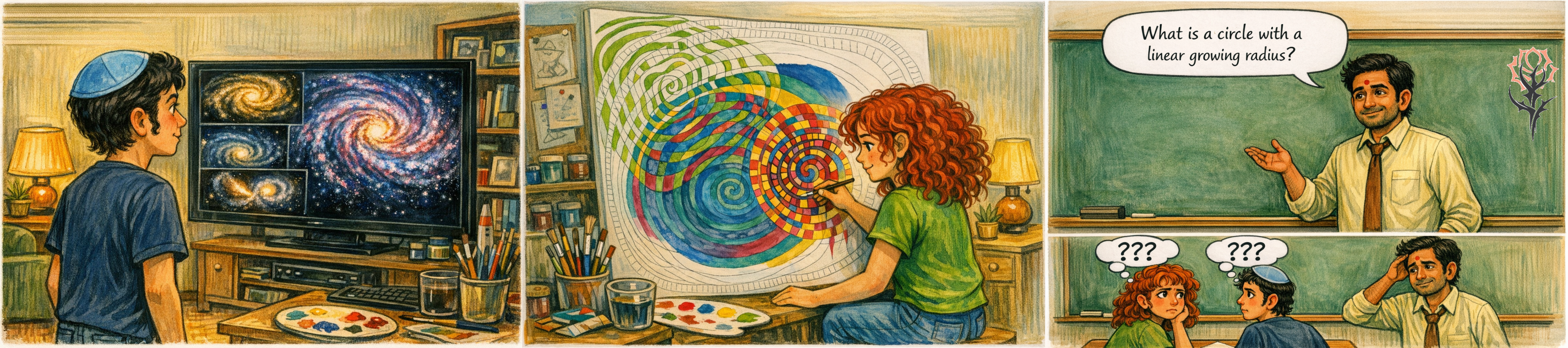
Prime Funnies: Comic Strip 1
Figure 1. Prime Funnies — Comic Strip 1 (© Birke Heeren, 2026)
Next: Comic Strip 2 ↓

Prime Funnies: Comic Strip 2

This contribution presents a creative mathematical comic strip designed to engage readers through humor and visual storytelling, illustrating how mathematical ideas can be communicated in an accessible and enjoyable manner.

Prime Funnies: Comic Strip 2
Figure 2. Prime Funnies — Comic Strip 2 (© Birke Heeren, 2026)
↑ Previous | Next: Comic Strip 3 ↓

Prime Funnies: Comic Strip 3

This installment of the Prime Funnies series continues to present mathematical ideas through engaging visual storytelling and humor, offering an accessible and enjoyable experience for readers of all ages.

Prime Funnies: Comic Strip 3
Figure 3. Prime Funnies — Comic Strip 3 (© Birke Heeren, 2026)
↑ Previous | Next: Comic Strip 4 ↓

Prime Funnies: Comic Strip 4

This installment highlights how curiosity, conversation, and everyday situations can make mathematical thinking both meaningful and engaging.

Prime Funnies: Comic Strip 4
Figure 4. Prime Funnies — Comic Strip 4 (© Birke Heeren, 2026)
↑ Previous | Next: Primary School Teaching ↓

The following contribution offers practical guidance for teachers and readers interested in how mathematics may be introduced in primary school through activity-based and visually meaningful approaches.

How to Teach Mathematics in Primary School: Simple and Effective Classroom Strategies

Abstract. Teaching mathematics at the primary level requires clarity, creativity, and meaningful connection to everyday life. This article presents practical classroom strategies that help teachers introduce mathematical concepts in a simple, engaging, and effective way. Emphasis is placed on activity-based learning, questioning techniques, visual support, and building confidence in young learners.

Teaching mathematics in primary school is not about presenting many rules or formulas. Rather, it is about helping children understand ideas in a natural, visual, and enjoyable way. A good lesson begins with something familiar, develops through activity, and leads gradually to understanding. When children feel that mathematics is connected to their world, they become more interested, more confident, and more willing to think independently.

1. Start with Real-Life Situations

Hands-on learning with familiar classroom objects
Figure 1. Hands-on learning with familiar classroom objects.

A lesson should begin with something children already know from daily life. For example, when teaching addition, one may use familiar objects such as pencils, books, fruits, or toys. A simple example such as “You have 2 apples, and I give you 3 more” allows the student to see the meaning of addition before encountering abstract symbols.

  • Start from the child’s own environment.
  • Use visible objects before symbolic notation.
  • Let students describe what is happening in their own words.

2. Use Concrete Objects (Hands-On Learning)

Children learning mathematics through activity and play
Figure 2. Activity-based learning helps children stay engaged.

Young learners understand more effectively when they can touch, move, and see objects. Useful materials include blocks, beads, sticks, counters, or coins. For example, to teach subtraction, remove objects physically and let students observe what remains.

  • Blocks, beads, sticks, or coins
  • Drawings on the board
  • Simple classroom materials

3. Move from Concrete to Abstract

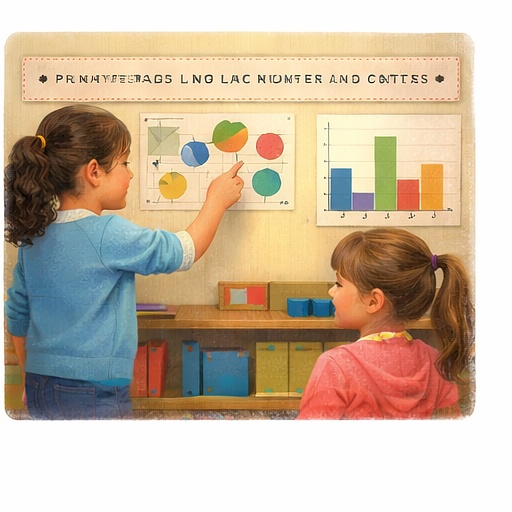
Visual tools such as number lines, charts, and shapes
Figure 3. Visual tools bridge concrete experience and symbolic understanding.

Effective teaching often follows three natural stages:

  • Concrete: Use real objects
  • Visual: Use pictures or diagrams
  • Abstract: Introduce numbers and symbols

For instance, in teaching 3 + 2, first show 3 objects and 2 objects, then draw them, and finally write the equation. This gradual movement builds understanding with confidence.

Teacher Tip

Do not rush too quickly to symbols. If a child understands the idea first through objects and pictures, the symbolic form becomes far more meaningful.

4. Ask Guiding Questions

Instead of giving answers immediately, teachers should guide students by asking thoughtful questions such as:

  • “What do you see?”
  • “How did you get this answer?”
  • “Can you try another way?”

Such questions develop mathematical thinking and strengthen confidence. They also encourage students to become active participants in the lesson rather than passive receivers of information.

5. Encourage Participation and Discussion

Teacher engaging children through discussion and storytelling
Figure 4. Discussion and storytelling make mathematics meaningful.

Students should be encouraged to explain their ideas in their own words. Even an incorrect answer can become a valuable learning opportunity. A classroom in which children talk about mathematics becomes more active, thoughtful, and engaging.

Story-based examples are especially effective because they connect mathematics with language, imagination, and daily life.

6. Use Games and Activities

Mathematics becomes more enjoyable when taught through games and interactive activities. Examples include counting games, number puzzles, matching shapes, and simple classroom competitions. Learning through play often improves both understanding and memory.

Classroom Activity

Give each child five counters. Ask them to make the number 5 in as many ways as possible: 4 + 1, 3 + 2, and 5 + 0. This simple activity introduces number composition, flexibility, and discussion.

7. Focus on Understanding, Not Memorization

Children should understand why a mathematical idea works, not simply memorize an answer. For example, instead of only memorizing that 5 + 3 = 8, students can build the two groups with objects and discover the result for themselves.

8. Build Confidence and Remove Fear

Children connecting mathematics with everyday situations
Figure 5. Everyday situations help children see mathematics as meaningful.

Many children feel anxious about mathematics from an early age. Teachers should therefore create a friendly and supportive environment in which mistakes are accepted as part of learning. Encouragement is often more powerful than correction.

When children feel safe, they are more willing to participate, ask questions, and explore new ideas.

Conclusion. Teaching mathematics effectively in primary school means making it simple, visual, interactive, and meaningful. When children enjoy learning mathematics, they develop confidence and curiosity; and curiosity, in turn, leads to deeper understanding and lasting interest. The teacher’s role is not only to present content, but also to open the door to discovery.

↑ Previous: Comic Strip 4

Community Forum

Announcements, recognitions, notices, and communications from the global mathematical community, reflecting the spirit and activities of ISQGD.

The Community Forum provides a space for sharing announcements, achievements, and resources across the broader mathematical landscape. It highlights contributions from students, educators, and researchers, fostering communication, inspiration, and collaboration in alignment with the mission of advancing mathematics from K–12 education to higher research.

Community Announcement — Example

This section may include announcements, selected achievements of students, educators, and researchers, book notices, resource highlights, and brief updates of broad mathematical interest. Contributions reflecting the evolving landscape of mathematics and education are welcome.

Next: Resource Highlight ↓

Book Notice or Resource Highlight — Example

Additional notices, brief reviews, mathematical communication pieces, and community-oriented contributions may be included here in future issues, offering insights and resources of interest to a wide audience.

↑ Previous

Publication Notice

Copyright, authorship, archiving, and future publication infrastructure.

Copyright. © 2026 International Society in Quantization, Geometry, and Dynamics (ISQGD). All rights reserved. Individual articles remain the intellectual property of their respective authors unless otherwise stated.

Archiving and access. This issue is intended for long-term academic access through ISQGD’s official website and related archival platforms.

Future identifiers. The Bulletin is prepared in a format suitable for future assignment of DOI, ISSN, and other scholarly indexing metadata as the publication expands.

Recommended issue citation.
ISQGD Bulletin, Volume 1, Issue 1, May 2026. International Society in Quantization, Geometry, and Dynamics.

ISQGD Bulletin

Volume 1 • Issue 1

May 2026

International Society in Quantization, Geometry, and Dynamics

The ISQGD Bulletin reflects the international and interdisciplinary vision of the International Society in Quantization, Geometry, and Dynamics (ISQGD).

It is committed to promoting clarity, rigor, accessibility, and global engagement in mathematical communication, spanning K–12 education to advanced research.

Contribute to Future Issues

ISQGD welcomes feature articles, expository writings, educational pieces, research-oriented articles, announcements, and community contributions aligned with its global academic mission.

Editorial Correspondence:

Dr. Mrinal Kanti Roychowdhury
Founding Chair & Board Director, ISQGD
Professor of Mathematics, UTRGV, USA

mrinal.roychowdhury@isqgd.org

🌍 https://www.isqgd.org/